Least expected.

City and mountains – a view common in Seoul.

One cold, late January afternoon,  we sped from Seoul across South Korea to Sokcho city.  It’s a two hour journey, once past the spider’s web of highways that weaves among the 25 million inhabitants of the capital.  In countless towers, people reach for the sky. From a distance, once humans become implied rather than visible, the effect is of calm white teeth, a dental display of high density housing. I was mesmerised.

I had very little expectation about South Korea.  Neither negative or positive.  A far country, stuck on to China, close to Japan, with a troubled history of occupying neighbours and war with its northern self in living memory.  Technological powerhouse, one time Olympic host and purveyor of Kimchi, which I’d tried at various Korean restaurants: I had a residual speckle of understanding for the country.  Without ever having been there, I suppose I anticipated one big, grey company town.

How wrong.  South Korea is beautiful.

It is also impressive, mountainous, architecturally neat and, in sparkling January sun, easy to love.  In the four days we were there, talking with a remarkable couple and their friends, I loved it very much.

In a perfectly round valley, known as the Punchbowl, up next to the border with North Korea and the De-Militarised Zone, are 20 hectares of land currently known as ‘The Apple Project’.  Here, a Mr and Mrs Kim are embarking on the next stage of their working lives.

The Kims ran a school in Seoul for over 30 years.  Since moving on, they have employed the world’s leading authority on apples.  This is no idle boast.  We learned in moments that there is nothing Mr Son doesn’t know about apples.  The Kims have also employed an exceptional garden designer and advisor.  Kyungah’s seventh book was published in the time we were there.  She lectures and broadcasts constantly.  She spent six years in the UK obtaining a doctorate.  Her early career was writing television.  She also has time to paint, design and photograph to exacting standards, besides fitting in a family life which has produced two bilingual daughters, one a fully qualified doctor, the other en route  for the UN.  She knew more about any single famous British garden than anyone I’ve met, but her knowledge extends to Europe, the US and pretty much anywhere else.

Apples change hands in Korea for up to £7.  That’s not per pound or kilo, that’s seven English pounds each – 0r 10,000 Won in the local currency.

We didn’t drink the Kool-Aid (our hosts were politely, but not Calvinistically, abstemious).  Nevertheless over four extraordinary days, I amassed enough evidence and personal experience to become convinced the Kims are in danger of producing the best apples on earth. Very rarely could I ever say that about clients I have worked with.  We tasted the fruit from neighbouring approximations of the orchards they planted just over a year ago both blind and side-by-side. We listened carefully to  Mr Son, via a translator, on his specialist subject discovering, besides a phenomenal knowledge of apples, a deep and gentle humour.  The Kims themselves are reacting to years of the working ethic that has accompanied South Korea’s economic miracle.  17 hour days, six day weeks and obsessive over-achievement have dominated South Korean working practice since the war with the North. The Kims want to create a business that leaves a more balanced legacy for subsequent generations. The Apple Project will become a destination where the young can go and live for extended periods.  Work Life balance is much discussed. Positive business ethics, sustainability, environmental probity and a do-as-you-would-be-done-by approach are so evidently stitched in to the enterprise, it is humbling.

At Big Fish, our job is to help them name, brand and design the Apple Project.  It’s a hell of a responsibility but it is also an exciting privilege.  We’re mid-way through.

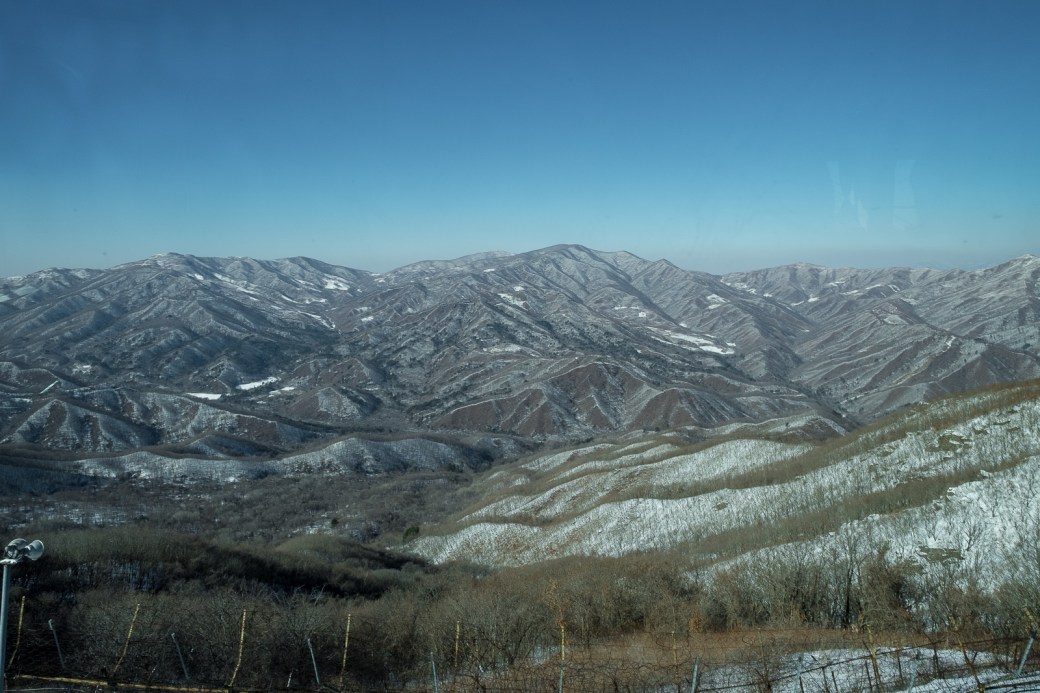
On our first full day in the secret kingdom tucked over on the border on the eastern side of the country, we drove up to an observation post and looked in to North Korea.

20170201-7782 A view into North Korea, through terrible tinted glass and trying to avoid a soldier shouting at me for taking photos when I wasn't alllowed to. From the DMZ observatory

The crenelated contours appear more folded hearth rug than home to the most repressive regime imaginable.  Looking closely, there were buildings and roads in view (the centre of the image above), but not a hint of humanity.  The South Korean border guards told us that we were looking at one of the most heavily mined landscapes anywhere, but also that the electric fences the North have erected are no longer electrified as the power to arm them is simply not being generated.

We looked hard at the landscape, in theory forbidden from photographing it. In the sun, it was bleakly unreal and strangely unthreatening.  Within days, Kim Jong-Un was to launch a flurry of missiles towards Japan and, according to the suspicions of journalists all over the world, kill his half brother at a Malaysian airport.

The home of paranoid belligerence stretched out before us.  A mile or two behind were the peaceful saplings of Mr and Mrs Kim’s dream, growing into reality under the snow.

Sometimes the excitement, tension, hope and circumstances of a moment combine to make you more than glad to be alive.

Just incredibly, amazingly lucky.

Crowded silence.

IMG_2666

Most days, I’m surrounded by people on the way to work. Mostly, they’re silent. If I vary my route and walk from Earl’s Court to our studio on the river, I’m still surrounded by people, also silent, but they don’t have a choice.  Brompton Cemetery is as packed full of characters as any tube.  It makes for a fascinating way to reach work.

I  spoke to a veg man in a farmer’s market recently who had moved to Deal from the capital when his kids were born.  He works on a Rudolph Steiner inspired farm.  The clincher for him was walking about his first morning in the coastal town.  He stopped counting the ‘Mornings’ and ‘Hellos’ after 15. He’d found the Britain his father, born in 1923, had banged on about. A far cry from encountering strangers this century in, well, just about any London borough, unless you’re a trainee barista.

The commuting silence is a special phenomenon. It may be under threat from smartphone bleeps and bloops plus the occasional, startling ring tone, but a particular kind of London code prevails.  This morning when an East European mariachi-meets-dixieland band stepped into the train at Hammersmith, the body language of my fellow passengers was, well, livid.  Silently, they were furious.

Tubes are funny places. Upwards of 60 people jammed into a very small space, for all the world as if they are standing, sitting or, most likely, wedged into a completely empty room.  In any other setting, you couldn’t – or probably wouldn’t -ignore your fellow man.  Here, it’s almost essential to do so. It makes for unsettling theatre, easy to overthink.  Church is the only other place that comes close.

There are myriad ways to commune with the ambivalent spirit of this city. Tube travel hardly ever includes you ‘in’, but it’s certainly one way to be part of it.

Classified.

1-69405l-2560x1440

Deckhand wanted for Caribbean cruise.

There were two phone numbers after this entry, in bold, in the small ads column of the Daily Telegraph.  They weren’t English ones.

I don’t read the Telegraph and never have.  Except this was a discarded copy, chucked onto the train seat opposite me. At that point, I scanned every job ad in every paper I could set eyes on. I wrote the numbers down.

Travelling back home on the train from Marylebone, I was returning after another strangled, failed interview.  I was trying for marketing.  Or advertising. Or tobacco trading.  Or just about anything I could think of.  My day job was working at the DSS (Department of Social Services) in High Wycombe.  I would sit in virtual silence, in a room with six others, putting up peoples’ pensions by 8%.  In the autumn of 1982, I remember that a married couple’s weekly pension allowance was £54. It wasn’t the most exciting way to spend the day.

That evening I rang the first number from the ad.  The ringing sound was long, thin bleeps.  A crisp and rather posh, English, male voice answered.  I was told to submit a CV to an address in London, and then await the possible call for interview.

That, I assumed as I joined my parents back at the kitchen table for supper, was that. I’d received an answer. Nothing I had ever done qualified me to be whatever being a Caribbean deckhand required.  I sent off the the CV as a sort of reflex action. Not much of a covering letter or any attempt to sell myself. I had nothing to sell, apart from very average exam grades and a geography degree. Still, nothing ventured…

A fortnight later, again in the evening, the phone rang.  Again, the same posh voice, brisk and to the point. I was instructed to be at an address, just off Park Lane, at 9.30am one day the following week.  Negotiating a day off from my civil servant duties, I went. I was twenty one. London hummed with exotic excitement.  The curl of cigarette smoke coming out of smart cafes as I walked nervously to the appointment reeked of metropolitan sophistication.

Exiting the elevator in an ill-fitting suit, my heart sank faster than the lift .  About twenty people were sitting around on the comfortable furniture of a large anti-chamber.  The age-range appeared to go up to grizzled, sea-faring folk in their forties.  There were accents of all kinds. I overheard low murmurs about knots and sails and storms.  I sat next to a bloke with enormous forearms.  A South African, he’d just sailed a trawler from Copenhagen down to Cape Town. I’d once sailed a toy sailing boat across our school swimming pool. My inadequacy began to make me feel woefully detached.

My turn came eventually.  I walked past the assembled bristle of maritime expertise and into a small office.  A tousle-haired chap sat with his head in his hands, staring intently at his biro.  He looked up.  His face was crumpled fatigue.

“You don’t look all that happy,” I said, to open the conversation.

“Yes. I’ve got a terrible hangover,” he replied with a grunt. Something about him spoke of the military. The voice matched the phone calls.  He flicked me a sharp glance. “Have you ever been sailing?”

“No.”

“Can you spot one end of a boat from another?”

“As long as it’s sideways on,” I replied, truthfully.  There was a pause. He went on, in a fractionally more kindly voice.

“Why do you want this job?”

“Because I’m working at the DSS in High Wycombe and it’s very boring.”

“Oh…Right.”   There was a longer pause. He scrabbled for some paper behind him and showed me a picture of a gleaming, fantastical vision of a yacht.  A motor yacht. A very big motor yacht.  Brand spanking new and – helpfully – sideways on.

“There it is,” he concluded.  “Pretty, isn’t she?”  I nodded dumbly.

“Well,” continued the military man with a hangover.  “Thank you for coming.”

“Thank you for seeing me,” I mumbled and backed out in what I thought was a pantomime of bravura tinged with suitable defeat. Game over.

Ripple dissolve to a fortnight on.  Again, at the supper table, at home, with my mum and dad.  (I was paying them rent of six bottles of wine a week from Wycombe Wine Stores.)  It was a Wednesday evening.  The phone rang.

“High Wycombe 30984,” I said.

“Hello.  This is Richard Wolf, captain of the boat.  You’ve got the job.  We’re in Southampton.  We leave on Friday evening.  Can you be with us on Friday morning, by 10am?”

“Er.  Yes,” I ventured and – after a scurry of resigning from Her Majesty’s Social Services inside one working day – I was.

My home, for the next six months, was the boat pictured above. It’s differently named today than when I crewed it with eleven other people.  It was the most extraordinary adventure – from Southampton, to Holland, Dover, Guernsey, Spain, the Caribbean and back to Antibes.  And it all started with a one line ad from a column marked ‘Classified’.

Copy that.

internet-marketing-workshop

Within a few months of landing a job as an advertising account man, I was being trundled off to helpful lectures by advertising luminaries.

Dave Trott held up five pieces of paper in a row – four with simple crosses and one with a circle.  Ron Collins delivered an hour’s worth with a Sooty glove puppet on his hand. David Horry waxed lyrical about the joys of Shepperton before, I think, donning a nun’s habit .

The lectures were held in the basement of JWT’s Berkeley Square office.  The series was kicked off by Jeremy Bullmore in what was unquestionably the best talk of all.  Funny, engaging and profound, he both connected with and conquered his audience of upstart graduates with effortless ease. Not for nothing is he still everybody’s favourite adman.

I remember him pushing hard on a point about inspiration. “If you’re going to pastiche opera,” he intoned like Humphrey Lyttelton, “then for god’s sake go and see an opera.  Never assume you know.”  The assembled account people listened hard, although his point was perhaps more resonant for copywriters and art directors.

The insatiably curious do better in advertising.  In other fields too. Anyone who soaks up any idiom or art form and has the ability to re-purpose or re-imagine it to the subject at hand has better tools.  Much was made of David Bowie’s hungry eclecticism in the obituaries – the fuel of his diverse output. He never contented himself with just one genre.

There have been legions of ads that take opera or classical theatre as a start point. Yorick, poor old thing, has been served up time and again.   One reworking of a classical theme to brilliant effect came from Adrian Holmes.  Pygmalion meets My Fair Lady, inverted and packed into a minute, the finished work builds the brand with quotable power. It also skewers British class lines with compressed magic.


Hilaire Belloc wrote a poem in 1929 that practically screams to be read aloud.

Tarantella

Do you remember an Inn,
Miranda?
Do you remember an Inn?
And the tedding and the spreading
Of the straw for a bedding,
And the fleas that tease in the High Pyrenees,
And the wine that tasted of tar?
And the cheers and the jeers of the young muleteers
(Under the vine of the dark verandah)?
Do you remember an Inn, Miranda,
Do you remember an Inn?
And the cheers and the jeers of the young muleteers
Who hadn’t got a penny,
And who weren’t paying any,
And the hammer at the doors and the Din?
And the Hip! Hop! Hap!
Of the clap
Of the hands to the twirl and the swirl
Of the girl gone chancing,
Glancing,
Dancing,
Backing and advancing,
Snapping of a clapper to the spin
Out and in —
And the Ting, Tong, Tang, of the Guitar.
Do you remember an Inn,
Miranda?
Do you remember an Inn?

Never more;
Miranda,
Never more.
Only the high peaks hoar:
And Aragon a torrent at the door.
No sound
In the walls of the Halls where falls
The tread
Of the feet of the dead to the ground
No sound:
But the boom
Of the far Waterfall like Doom.


I scribbled the following when my life was dominated by horribly dull marketing workshops. They were held in horribly characterless rooms, all over the world.   I found myself thinking of Jeremy Bullmore’s advice.  I couldn’t avoid the workshops – but I did spend some time with Belloc.


Marketing Offsite

Do you remember a thing, Amanda?
Do you remember a thing?
And the queues and the booze and the unpleasant loos
And the leers and tears of the young marketeers
At the tediously dull seminar?
And the strict lack of tact as we yakked of the sacked
(Or the tales from Sales of a big philanderer)
Do you remember a thing, Amanda?
Do you remember a thing?
And the syndicate work with the berk from Selkirk
Or the rep – so inept – who you wept with, prepped with,
And Dawn from HR slept with
With the nasty shiny tie and that skin?
Or the bish bash bosh
And the tosh
Of the MD’s
Speech as he screeched that we reach
Daft targets that he preached
Were do-able, he knew-it-all,
The twat, he claimed that, through it all,
Our interests were best observed by him?
Do you remember a thing, Amanda,
Do you remember a thing?
And the boring little jawings
Of that dreadful man from Goring
(As you fled from the bar, going green, Amanda)
His one-liners bombed like Stukkas
As you sicked up your sambucca
And the heave-age of your cleavage in the car?
Do you remember a thing, Amanda?
Do you remember a thing?


Never more;
Amanda,
Never more.
Only the delegates snored
As I dragged you through the door
And wallop
On the bed of man-made threads
You shed
Your office inhibitions like a trollop
Please forget
That we met
Next week, as we sit, at our desks.

Menu speak.

50f47dee2a541.jpg


Overwhelmed?  Unimpressed?  Banjaxed?

Menus are fraught with potential complication.  The first time my art director and I were taken to lunch by our boss, John Hegarty, we were handed menus like encyclopaedias.  We were nervous little squits. The restaurant was all Eighties Soho glitz.  Our employer gracefully signalled to the waiter that we were to choose first.

Lots of overcomplicated expressions about ‘jus’ and ‘semi-freddo’ swam before our twitchy gaze.  Aware we were shortly to be appraised, bollocked and – quite possibly – fired,  the art director swallowed,  saw the word ‘tuna’ written in an over-filled sentence and jumped on it.  “That,” he said, “I’ll have that.”

There was a beat before the waiter, with a malicious glint, leaned forward. With theatrical sadism, he murmured, “Yes.  And to follow?”

David – my brilliantly Irish art-director-in-arms – floundered in defeat.

Later on, I once spent three days wandering about in Prague with the entire creative department of Boase Massimi Pollitt.  In between copious amounts of beer, boiled meat and – curiously – a visit to the Sindy Doll museum with nearly 4,000 of the plastic toys in different costumes, the conversation revolved around inventive menu speak.  Matt Lee won the day with “Steak With A Rumour Of Marmalade” (his capitalisation).  It was way ahead of Heston.

Later still, I continue to work with the splendid Lee Anderson, a Big Fish secret weapon.  His trademark deadpanning masks an extraordinary gift.   He wins hands down with the unspeakably uneatable in the following list:

                                         M E N U    D E   N O S   J O U R S  

                                  §

                      Flash-poached ‘Beryl Reid’ of lamb served with a mint ‘fist’.
                                 §
                   Inside-out pork ‘badge’. Served from the ceiling on invisible wires.
                                §
                Puree of burger and chips. Comes with a side of normal burger and chips.
                                §
                                Cold, hot, then-cold-again pork. Served warm.
                               §
                                    Spam-cooked giblet rims. Served on a bed.
                                 §
                                 Hand-slapped pig. Served shamed and on a puree of crisps.
                                  §
                                         ‘Glimpse’ of turkey with a beef ‘mist’.
                                   §
                                      Plate-sized jumbo pea. Served with a photo of scrambled eggs.  
                                      §
                                                 Fillet of entire horse. With chips.
                                     §
                              Recently ‘told-off’ chicken. Served live with a savoury ‘sand’.
                                      §
                                        ‘Catastrophe’ of snake with ‘big’ sauce.
                                      §
                                                  ‘Monkey’ of donkey on toast.
And to follow?
Perhaps best just to ask for coffee, the bill and leave it there.

Briefly.

IMG_0344

Willy Robertson was the only soldier ever to rise from private to Field Marshall in the First World War.  It was no surprise that he was refreshingly free from typical officer-class stuffiness.

Some time afterwards, Robertson was asked to make a speech at a school prize day.  The headmaster waffled on in his introduction. The Field Marshall rose.

“Boys,” he said, “I have a great deal to say to you but it won’t take long: so remember it. Speak the truth.  Think of others.  Don’t dawdle.”

Then he sat down.

Brevity counts for much. It is the soul of wit.  It is wonderfully memorable.

US president Calvin Coolidge was famously taciturn but not without humour.  At a dinner, a young woman seated next to him said she had bet a friend she could get him to say more than three words.  Without looking at her, his reply was succinct.

“You lose.”

One of my father’s favourite quotes was an unattributed truism. It describes, with admirably concise precision,  how a powerful human emotion travels.

“Love descends.”

You can’t fight gravity.  You can’t beat brevity.

Myths that hit.

tumblr_lmxrulFVaf1qfvq9bo1_r1_1280

A tourist walks into a remote bar in the Everglades and spots Ernest Hemingway.  Falling into conversation with him,  the tourist asks, “How short can a short story be?”

“Six words,” replies Hemingway.  And he writes, on a napkin, the following:

For sale.  Baby’s shoes.  Never worn.

QED.  The stuff of legend.   Beat that.

Except that there are several versions of how the story came to be.  One suggests the great writer challenged others at a lunch at The Algonquin to create a six word story. Another  that he produced it as a result of a bet . Go digging – not hard with a browser – and one finds the same, very short story was in newspaper circulation when Ernest Hemingway was only ten.

The version he is supposed to have written never actually happened.

It’s a myth.

But it’s an incredibly powerful myth.  There are now whole websites dedicated to six word stories (http://www.sixwordstories.net/category/site-news/). The genre of ‘flash fiction’ has grown from an idea about unsold infant footwear. Challenging someone to capture a full narrative with a handful of words and then triumphantly proving it possible with the ‘For Sale tale’ is irresistible.

Myths are a powerful weapon. Stalin put it about that Georgians lived longer than anyone else on earth. The ‘reason’ being that it was thanks to their diet.  The USSR, force fed this news by the State,  believed it.  Expectations for the longevity of their Georgian leader soared as their hopes sank.  Mohammed Ali’s approach to the Rumble in the Jungle – topical as pleas for his British ennoblement boil forty years later – was to create a myth that George Foreman swallowed wholesale. The version of himself that Ali then presented in the ring was so different, it undermined any pre-established narrative. Ali won famously.

Writing about another mythic invention, Robin Hood,  in the London Review of Books, the author James Meek says:  “Myth is a story that can be retold by anyone with infinite variation, and still be recognisable as itself…It is an instrument by which people simplify, rationalise and retell social complexities. It’s a means to haul the abstract, the global and the relative into the realm of the concrete, the local and the absolute… If those who attempt to interpret the world do so only through the prism of professional thinkers, and ignore the persistence of myth in everyday thought and speech, the interpretations will be deficient.”

Myths are fabulously communicative.

Our family grew up on stories my father told. They were frequently mythical, often fantastical. We had no way of proving them true or otherwise. He often spoke of our relations. Our maternal grandfather, in particular, inspired a one-man Aeneid of far fetched tales. Sadly I never met him.

One particular story has stuck with me.

Our granddad won an accumulator bet in 1922, worth millions by today’s standards. In the years that followed, he blew the lot. One adventurous purchase was a coffee plantation in what is now Zimbabwe. He took the family to live there and my mother was schooled in Harare (then Salisbury), until the coffee crop failed in 1936 and they moved to Zanzibar.

In the early days on the coffee plantation, they were plagued by a troop of chimpanzees. When chimps put their minds to it, they can be incredibly destructive. Huge areas of coffee bushes were being torn out of the ground and the crop was being lost.

It being the early 1930s, my grandfather arranged a shoot.  The neighbours joined him, so 16 guns set off, in search of the chimpanzee vandals.  My grandmother went along too as the only woman.

They walked for some hours and, eventually, tracked down the troop.  There were about 30 creatures, happily playing games of total vandalism.  So absorbed were they yanking coffee bushes out of the ground, they failed to notice the encircling men.  My grandfather raised his rifle.  His 15 companions followed suit.

Too late, the chimps realised something was up.  There was a stand-off moment. In that brief pause, one female chimp nursing an infant, stepped very pointedly towards my grandmother. The ape carefully placed her baby down in front of the only woman present, before stepping back to join the other chimpanzees, seemingly waiting to be shot.

In that moment, my grandmother called out. She said something as simple as, “You can’t do it”.  The guns stayed silent and were lowered.   After a few moments, the mother chimp shuffled forward and picked up her baby. The circle of men parted.  The whole troop filed out past the shooting party and away.

The chimpanzees never came back to the plantation.

My father told us this many times over the years, with theme and variations.  Thinking about it now, I believe something like that may have happened, but if it’s not pure myth,  I’m sure it’s heavily mythologised.   Nevertheless, it meant something very powerful to us children. It may not have been the truth, but it spoke – and speaks – of much broader truths. I will never forget it.

Back in the world of six word stories, I continue to come across them in all manner of places.  Writing them is a good exercise to set in workshops, simultaneously demanding compression and expansion in the minds of the participants.

Not so long ago, I was marooned in a huge, windowless room in Istanbul for three days with over 300 people from the same agency network.  At one point, we were broken down into smaller groups and frogmarched through all manner of tasks, challenges and tests.  The light relief was when the speaker asked our crowd of around forty people to try coming up with a six word story off the top of our heads.

There was a brief silence among the cabin-fevered, light-deprived people assembled until a dryly laconic, unmistakably Australian and very male voice lobbed a thought up towards the stage:

“Convent life.  Worth the sex change.”

Typical form.

IMG_2633

Aged 13, I had an extraordinary RE teacher.

The Rev Peter Hardman was something of a challenge to the school authorities.  He played Pink Floyd during Sunday services and also invited the school rock band (Keith’s Mum) in to play live too.

Baffled and delighted, we nicknamed him Hippy Hardman. Four years later, I can remember him driving us up to Liverpool for the day to experience West Kirby first hand.  Over forty years on, I appreciate his determination to make us look beyond our privileged surroundings.

He asked us to write a fairy story for our weekly prep.  This, unedited, is what I wrote in January, 1974.

FXP 99F.

Once upon a time, there was an Eastern prince. He was exceedingly handsome and rich and all the princesses wished to marry him.

But he had a motor car which he liked better than anything, a Rolls Royce given to him at his christening with registration number FXP 99F. He received it from a very rich uncle who had three, and really only needed two.

The prince loved this motor car more than anything.  He cared and looked after it very well.

On Monday, Princess Pomple arrived during his tea-break to see him and ask him to marry her, but instead of drinking tea he was polishing the hubcaps, and was consequently too busy to see anyone, even her.

On Tuesday, Lady Arabella Thumbsqueak arrived at lunchtime to see him and walk with him in the gardens, but the prince had missed lunch and was just checking the oil, and did not wish to see anybody.

On Wednesday, Princess Martha Crumpet arrived at breakfast time to see the prince and ask him to dinner that night, but he was taking FXP 99F out for a little ride to make sure it was still working.  The butler advised her to ask somebody else.

On Thursday, the Duchess of Dew arrived at eight o’clock for dinner, but he cancelled it, and went and washed the windows.

On Friday, Baroness Freagle arrived at dawn to see him; he was cleaning the seats, and so she didn’t.

On Saturday, hordes of pretty princesses arrived to ask him to marry them, but he was overhauling the engine and spent all day doing so.

On Sunday, the prince died, from starvation and overwork.  He had been too busy with FXP 99F and had not eaten at all.

So all the princesses went and married princes who were brave and killed things like dragons.

The END.

Words of character.

The British Design and Art Direction Awards dinner of 1997 was a bit of a car crash.

Kicking off in the Odeon, Leicester Square,for the actual Awards, the assembled then had to walk to the Cafe Royal just off Piccadilly Circus.  The dinner, dancing, drinking and other diversions were spread out over several floors.

Chaos ensued.

The great, the good and the liggers of both advertising and design tottered past the West End crowds in glittery heels and various approximations of black tie dress.  (Told to conform to  dress code, young creative turks rigidly conform to the ‘anything but’ principle and look uniformly ragged. The women, eyeing the menfolk pityingly, seize the opportunity to dress up and be their truly fabulous selves. ‘Twas ever thus.)

The after-event consensus was that the evening lacked ‘heart’.  A bold idea to up-end tradition became as lost as some of the creative types blundering about (what was) the Swiss Centre. Marooned, yards from their destination, they fluttered like mournful moths.

All of which overshadowed the originality of the peripatetic event. I was happily roped in by the brilliant Mike Dempsey to help produce much of the ticketing and programme stuff for the night.  Mike is an extraordinary designer. His original idea was to champion language and writing across all the various pieces.

The results are shown here. It was one of the most enjoyable collaborations I’ve ever undertaken. Right down to the VHS video cover – how quaint now – and the goody bag that guests took away with them, I had free reign to try and pump character into the text.

The next year, the advertising and design villages were duly back in the Grosvenor House, busy chucking bread rolls about and failing to tip the long suffering loo attendants.

IMG_0397IMG_0399IMG_0401IMG_0400IMG_0398IMG_0403IMG_0404

Failure.

Buxted-Park-Hotel-9


It’s been a while. Off doing other things, pausing a while, all sorts of vague, platitudinous excuse-y stuff.  Time to ramp it up a little.

The following was scribbled in a poetry workshop that happened in 2003. The event was sanctioned by my then agency, DDB London, and run by the wonderful Paul Feldwick. We spent three days in Buxted Park, a hotel combining extraordinary beauty with Fawlty Towers chaos. I loved it.

We were encouraged to think about the idea of freedom to fail. Ahh, I thought…

UPS AND DOWNS

I’d rather fall
When aiming high
Than die
Not having tried at all.
I’d rather, falling,
Know beneath
Await no shredding, vicious teeth.
I’d rather fall
However fast
And know my vertigo
Outcast.
Not that falling should be bliss
But if you never fall
Get this:

Ups without downs
Aren’t ups at all
They make the landscape
Empty.
Small.