Backwards and forwards.

Lady in her home, Bahamas

Lady in her home, Bahamas.   ©Ken Griffiths 

We decided to drive down to the water’s edge.  A liberating, carefree escapade. Lured by  thoughts of a white sand beach, edged with palm trees, and the Caribbean lapping seductively at its fringes, Chris steered our monster of a jeep down the short track.

Except that it was long after midnight.

Our organiser and driver, Chris Abel was the account man. He was also an unstoppable, go-getting force of nature, full of boyish swagger. We were on a photographic shoot for a press campaign for our client,  the Bahamas Tourist Office.  Martin Galton was the art director, I was copywriting the stories and Ken Griffiths was taking the pictures, assisted by Giovanni Diffidenti.

A few weeks previously, Martin, Chris and I had been on a ‘fam trip’, organised by Sir Lynden Pindling’s government, to get to know his country: twenty five days of four-seater planes, luxury hotels, exotic feasts and debilitating cocktails.  A louche crowd of European agency and PR types,  some ad people from Charlotte, North Carolina and a hilarious product placement duo from Hollywood, we were run through a tight schedule of 5am starts and (slightly looser) finishes, usually swaying near a swimming pool surrounded by empty glasses. We saw more of the islands than most Bahamians see in a lifetime.  The hoteliers treated us royally. Hard work it was not.

Now we were back for ten days with Ken, a justly celebrated and brilliant photographer.  This was a first night off in a week.

The four-by-four jeep radiated bulky confidence.  Dirty, rusty brown, it roared and snorted as we bounced towards the beach.  The Eleutheran night cloaked us in thick, humid comfort. I’m not sure if we had Ken’s priceless Gandolfi camera on board, but we certainly had some gear besides myself and Chris.  The photography team and Martin had retired, sensibly, to bed.  We’d drunk our own bodyweight in Kalik beer and whatever rum we found flowing through the small settlement of Governor’s Harbour.

Just as we reached the beach, there was a loud, percussive ‘kerrunnnkk’. Our wave of alcohol-fuelled positivity – and Chris’s extraordinary forward momentum – came to a immediate halt.  The truck stopped.  It wouldn’t move. We sank several inches into the sand while the engine whined. Chris swore a lot. We jumped out.

The big-wheeled wolf of a jeep turned out to possess far more of a sheep-like engine than its looks suggested.  The axle had sunk into a pothole, settling into the soft, dusty sand and now the thing refused to budge. Suddenly the lapping waves sounded like an ominously advancing tide. Desperate to reverse the vehicle, we rocked it to and fro on hastily gathered drift wood splints, but it simply sank further with our feeble efforts. The engine whinnied on pathetically, with no horse power to go backwards.

We were drunk, in charge of government property, on a beach where we shouldn’t have been driving, without insurance. A world-class photographer was depending on us getting him to the right spot the following day. The tide appeared to be coming in.  A joy-riding write-off of thousands of dollars of equipment wasn’t exactly going to play well with our London bosses. Those smart Bahamian police might show up at any point and throw us in jail. Not that unlikely a prospect, given how little else there seemed to be for them to do.

Panic, paranoia and palpitations set in, mixed with extreme tiredness as elation gave way to sick dread. Eventually, having scrabbled at the sand with our bare hands, broken finger nails, fallen palm fronds and anything we could throw under the wheels for approaching an hour, we wandered back to our simple hotel, about a five minute walk away and slept. I dreamt of the tide engulfing the vehicle and all the equipment being washed away.

About two hours later, as dawn broke, we woke up Giovanni and explained what had happened.  Calmly and without surprise, he walked down to beach with us. The first relief was that the tide had been minimal and the jeep was still dry, twenty feet from the sea. The Italian solved the problem in seconds flat. “Let’s try driving forwards,” he suggested and took the wheel. While Chris and I gave a simple push from the back, he did just that. It had never occurred to us to try it the night before.  The jeep bucked up onto the freshly wet sand.  The tyres dug in and held.   Giovanni drove off, through the shallow water at the shore, back on to the road and on we went to a day of photography in bright, sparkling light.

The campaign, such as it was, became four press ads. Sir Lynden Pindling, the Bahamian prime minister, came under more and more scrutiny as his personal wealth grew, seemingly without explanation. Amongst allegations of backhanders from Colombian drug lords, there was a strong suggestion that the advertising campaign had been conveniently been put together as a “tax dodge”or, possibly, to throw the opposition parties off the scent of corruption. It was never properly explained.  Soon after, Sir Lynden was removed from office, despite the affection of many Bahamians. The account quietly slipped away from BBH.

Giovanni graduated from working as Ken Griffith’s assistant, going on to become a brilliant war photographer.  His images from countries affected by conflict are seering but always human.

Martin and I continued to see Ken back in London, as his editorial work continued, particularly with The Observer.  The trademark, Antipodean tones never left him.   He died of motor neurone disease aged 69 in 2014 after a difficult few years.  His work still packs a cinematic punch, vivid portraits not just of people, but places and a particular epoch.  The shot at the top of this piece was captured in a little house in a short interlude, during our time there; the one below is from his dignified study of the homeless in London, entitled Dossers.

www.kengriffiths.co.uk/projects/

www.giovannidiffidenti.it/portfolio/

Ken Griffiths with Dossers

Ken Griffiths with friends, Lincoln’s Inn Fields ©Ken Griffiths 
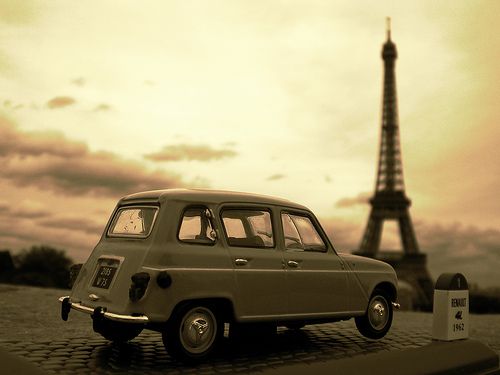
The Polish hitch.

Renault 4 Paris 1976

It was hot and sultry and I was standing by a dual carriageway.  Car after car sped past me under flat, white skies. I’d been there since before noon, facing the oncoming traffic, standing hopefully upstream from a lay-by.  My rucksack was parked discreetly on the verge.  I didn’t want to look like a bulky passenger.

It was a Saturday in September, 1976.  That morning, I’d had one ride from south of Clermont Ferrand to a roundabout outside Riom.  A journey of perhaps 15 minutes.  Paris was still over 400 kilometres away.  The train to the Calais ferry from the Gard Du Nord was booked for noon on Sunday.  Anxiety gnawed away as minutes became hours.  Comfortably fed French drivers buzzed past, heading home or out shopping,  blind to a hitchhiker during their precious weekends.

For ten days, two school friends and I had walked around the volcanic landscape of the Puy-de-Dôme. Starting in high summer, our westward march towards Mont-Dore had been magnificent.  As we began to circle back, the season tipped;  skies were painted a deeper, technicolour hue and heavier dews drenched the grass outside my tent. Autumn beckoned, but the heat held.

My companions, Mike and Tim, were both 16.  I was a year younger.  Hitchhiking as a trio was a non-starter, with three large rucksacks.  For our journey back to Paris, we decided to split and I would go solo. The theory was that I spoke better French. Standing in the headachy light, my stomach a washing machine of worry,  any confidence ebbed steadily into the grass. I told myself I’d wait until 4pm and then get to a train station, heading for a bigger town north and better hitching conditions.

I played games in my head.  In the next fifty cars, one would stop.  It would be the third red car.  Or the seventh white one.  It would be a couple.  A family.  It would have a roof rack…  Not one of the bets paid off.  Slightly numb, I stopped looking into each windscreen and kept my thumb out.

There was a creak.  A metallic sigh.  Coming to, I looked at the lay-by behind me.  A dark, battered Renault 4 had braked and pulled in.  The overshoot suggested it hadn’t stopped for me.  I stared, blankly.

An owlish, bespectacled head manoeuvred its way out of the driver’s window and peered back. The passenger door opened, and a woman leaned out.  Her hair was in a bun.  They beckoned me to join them. I trotted up.  In amongst a torrent of ‘Merci’s’, I mumbled “Montlucon?”, “Bourges?” and, chancing my luck, “Orléans?”, with what I hoped was polite intonation. They simply indicated that I should get in.

Vaguely but charmingly, the couple said they were heading north.  They must have been in their late sixties.  She was very neatly presented, he a caricature presentation of French dressing.  A moustache. Slightly unkempt hair.  A dark blue serge shirt with an even darker, shapeless waistcoat.  We drove on while I explained myself,  what I had been doing and the plan to get to Paris to go on home. My school term was waiting.  After as full a description as my schoolboy language skills could furnish, the conversation petered out. We kept driving.

A wave of relief to be on the move engulfed me.  I was glad the interrogation had stopped. For the moment, I didn’t want to contemplate the next step. Ahead lay the ladder of lifts required to reach Paris and its inner city ‘camping’. (In the Seventies, the campsite was a celebrated heart, revered amongst the itinerant tribes of student travellers coursing round the Republic’s arteries.)  I closed my eyes and drifted.  Vividly, to this day,  I can remember hearing the neat, precise woman murmuring clearly to her husband, “He’s very young. He’s been in the sun all day long.”

I woke some time later as we stopped to get petrol, somewhere near Orléans.  The car had been travelling for two hours.  Awkwardly, I apologised for having been asleep for so long, but the apologies were brushed off.  They gave me sweet biscuits from a packet with a smear of jam in their centre, and we drank water.

They told me they would take me all the way to Paris.

I spluttered my thanks, amazed.  The drive went on for hours more, streams of traffic cloying to thick rivers in the closing stages.  The city was in full rentre mode, as holidaying Parisians returned from the south. Against the dying sunset, the distant skyline took on the painted qualities of Disney’s The Aristocats.  A quiet, excited satisfaction about re-meeting my companions began to grow.  I was still unsure of how to get to the Paris campsite and nervous at the prospect of spending the night there alone if they’d failed to make it. School abounded with tales of druggie hippies and campsite thefts. Mobile phones were still, effectively, twenty years off. There were plenty of reasons to remain anxious.

The couple were called Slobojanski.  We chatted on and off on the trip, but they didn’t go in to their past in any detail. To my ear, they sounded emphatically French but they told me their family came from Poland.  As we headed inside the Périphérique, it was after 10pm. At that point, Mme Slobojanski insisted, politely but firmly,  that I would spend the night with them at their apartment.  Overwhelmed, I was reduced to another torrent of thanks and then, swiftly, mute gratitude.

Their flat was somewhere in the north of Paris, a single room with a bathroom off it.  Their bed was in an alcove curtained off from the main living space and kitchen.  I think we ate bread and cheese.  I was exhausted. They pulled the curtain across and I slept on cushions on the floor.  The following morning, Mme Slobojanski produced milky coffee and a tartine, before Monsieur proudly took me down to the basement car park to show off his motorbike.  I knew – and know – as much about engines as a baguette, but his eyes gleamed as he talked through the pistons and sprockets.  The bike had the same, petrolly smell as my father’s Atco lawnmower and looked of similar, antiquated vintage. My host’s reverence for the machine was palpable, a passion buried all the time he’d been driving the day before.

Mr Slobojanski drove me to the Gard du Nord after I said my effusive goodbyes to Madame. They flatly refused any offer of money.  Instead, Monsieur dropped me off with a smile but little ceremony, and within two minutes, I spotted Tim and Mike making their way into the front of the station.  Our return to England was uneventful.  From home, I wrote to thank my special French Polish hosts again.

Years later, I look back at what happened and realise the true meaning of the word, ‘generosity’.  Helping without fuss, the Slobojanskis were clearly neither wealthy,  nor ostentatious. They showed immense, unquestioning kindness.  My lucky encounter embedded a belief that only by keeping your heart, mind and – especially these days – borders open, will you benefit from anything approaching the best in life.

Love a duck.

Christo orange gates 2003

One icy morning in early 2003, I walked through Christo’s art installation in Central Park. I was in New York to oversee a MacDonald’s shoot as ‘our man from London’.  It was a strange visit.

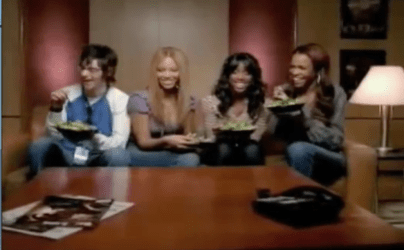
Destiny’s Child had been contracted by our Chicago agency to help publicise various new salads. Suddenly MacDonald’s was all about health.  Slightly tricky for a burger chain. In the end, an entirely forgettable piece appeared across the US and Europe. A breathless 30 seconds, it reflected a collision of agendas and too many peoples’ involvement.

Away from the shoot and all that went with it, colours that popped became my personal theme. Once again, I marvelled at the role of sepia in New York City.  Manhattan at street level is all browns, rust, ochre, sallow yellows and smoky dark reds. These were accentuated by wet-black trees in the park and grubby snow. When blue finally arrived, the day I left, it was as if the skies had launched a vivid, crystal fightback.

However, that first morning, the sky remained grey and sullen. My ears froze to biltong as I walked to the Applejack Diner.  Christo’s famous gates provided a brilliant, shocking distraction.  Walking under one curtain after another, around the ponds, along winding pathways, was to march through a monochromatic landscape hijacked by an outbreak of Dutch patriotism.  Orange! Orange! Orange! shrieked the material as it flapped.    The effect was mesmerising and – almost – warming.

Later I attended various production meetings. The local creative team and producer talked me through their TV ad featuring the all-conquering girl band.  Destiny’s Child was zooming to global fame. It was debatable whether the salads ever would.

The agency people were charming and apologetic. The singing trio had been forced upon them. There were all sorts of contractual absurdities.  The three ladies had to be given equal screen time.  There was a ton of food footage – basically, tumbling lettuce and sliced apples – that had to be crowbarred in somewhere.  It had ‘turkey’ written all over it.

The director was a man operating at cocaine speed. Jim Carey crossed with Tigger, all optimism and two-handed, finger and thumb framing as he talked shots into the air. His confidence was absolute, right up until we started shooting.  From the first call of “Action!”, it leaked out of him in a flood.  He was useless.  I discovered that American directors walk off a commercial shoot and abdicate further responsibility.  Every single director I had worked with up to that point would cut his or her own footage.  In the US, the rushes are handed over to the agency.  As a consequence, the director has no creative responsibility for how the footage will glue together, only a contractual one.  It makes for a horribly transactional relationship.

The story in the commercial was good enough.  A delivery boy rocks up with MacDonald’s salads to a studio. To his surprise, he delivers them to Destiny’s Child.  Having brought a back-up bag, he joins them.  Cue embarrassed – and hopefully funny – end tableau. Except that, interlaced between this touching narrative, was to be branding, millimetric equal screen duration for each band member and a Niagra Falls of tumbling, edible vegetation.  Time allowed, 30 seconds.

Beyonce  Destiny's Child Eat salad

I headed to the location on the second morning.  We were using an abandoned office in midtown, over on 10th Avenue, a dismal zone of transition stuck on early change. For a few blocks, the cross streets ran eastwards as a series of long, open sores. The optimism of any new development was still eclipsed by tyre businesses, welding shops and engineering outfits. These sometimes nameless quacks of the automotive trade were struggling – in the main – to keep their metal patients alive for a few more miles.

Wet snow dripped off the canopy of the catering truck, a grey, beaten thing like an Airstream after a fight. Gritty snowflakes blew into my breakfast burrito.  The wind was scathing.  Our film crew cupped their hands around their coffee cups for heat and blew off the steam. I looked through the set-ups to be filmed, nodded at the various and sundry MacDonald’s people and re-met my agency hosts. The producer suggested, with bright enthusiasm, that I “Go check out the wardrobe”.

For a second, I registered the absurdity of the idea.  He meant me.  Me.  Assessing whether the three, world famous members of Destiny’s Child were wearing the right costume in which to consume salad. In mid winter. But with an appeal for a screening later in the summer.  Something lettucy, perhaps, I thought.  Light on dressing, maybe…

My dubious, mental riffing stopped abruptly at the artists’ trailer. The door was both guarded and, in the memory, dwarfed by the band’s security man. Shorty was six-foot-eight of dreadlocked, barrel chested, cliff-faced good humour. He sported bottle top specs. His grey leather jacket stretched across a vast torso with enough material to give Christo a run for his money in fabric acreage. To complete the picture, he was fabulously gap-toothed and spoke with gentle, lisping consideration. He waved me in politely.

I stumbled in to the caravan, an oven of scented femininity after the arctic street.  There sat the three singers, hair in curlers. The make-up lady fussed around them. Beyoncé was wearing a stretchy purple top and smiled incessantly.  Kelly’s foundation made her face orange in the make-up mirror, reflecting the glow of the lights. Michelle, for whatever reason, was grumpy and didn’t want to play. Her hair, in particular, was richly fabulous at close quarters. From a distance of about four feet, I nodded and said something ineffectual like, “Well that all looks very good,” and fled.  Apart from saying goodbye at the shoot’s conclusion, that was it.  Hardly a full and frank exchange.

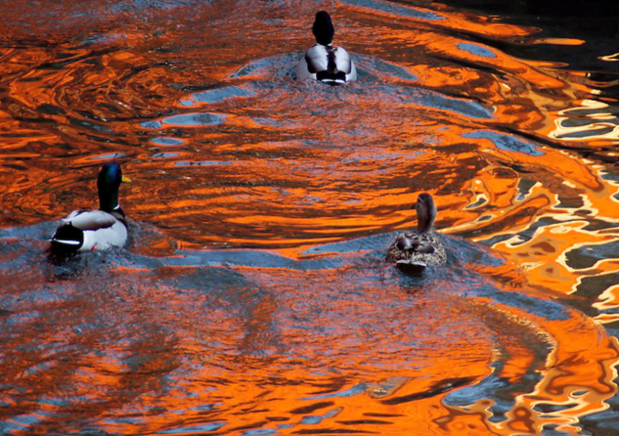
Away from the filming, the colours continued to ambush me. Besides Christo’s orange that first morning, I had also noticed some ducks paddling in the ponds around the outdoor art installation.  Completely uninhibited by the snow, piercing wind and – presumably – freezing water, they were going about their business with the same energetic determination as the rest of Manhattan.  In particular, there was one mallard, green as an emerald, a scimitar of deep, dark, sharp colour that grabbed my attention.  This bird was luminous. It made for a fabulous counterpoint to all that orange.

The image burned into my retina and the memory more than anything else during the whole visit.  In those Blackberry days, I had neither phone nor an ordinary camera to hand. Instead, I jotted down a few notes to try and do it justice. Fifteen years later, and with only a little embellishment, you’ve just read them.

The title I bunged down at the time was, ‘The lucidity of ducks’. The image below, sadly without green, gives you a hint of what I saw.

 Ducks in Christo reflection

Trial by tannoy.

Tannoy speakers

In January, 1979, Ultra Electronics Components Limited was based at the Loudwater end of the Wye Valley, one of a straggle of no-man’s land factories merging vaguely into High Wycombe. Three or four hundred people worked there, turning out hundreds of tiny plastic bits, squeezed and trimmed to the specification of the motor industry, the telephone world (still blithely unsuspecting of Californian upstart Apple) and various telly manufacturers. The inner workings of most TV sets remained as solid as a mangled locomotive.

I’d taken seventh term Oxbridge exams, enjoying being a prefect and luxuriating in the privileges afforded to pupils in their last months at a boarding school. Somehow, I had managed to wangle my way in in to Oxford (A Levels: 2 ‘A’s’, a ‘B’ and a ‘D’) on a flukey ticket. I was heading to Brasenose, to study Geography. One of only two students of the subject to be taken on that year, we knew that we would be taught by an external tutor at Saint Catherine’s.  Catz was a modern, rebellious, car park of a College, seething with very different values from any experienced at Marlborough College, Wiltshire. They’d had sit-ins, strikes and near riots amongst the highly politicised student body.  Brasenose, stuffed with lawyers, was invisibly complacent by comparison.

Home for Christmas, my next quest was to earn some money before heading off somewhere exciting for a few months. The notion – or cliché – of “Gap Yah’s” hadn’t really entered popular culture yet as a good, bad or divisive institution.

I started in the accounts department at UECL thanks to a placement from a job agency. My mum drove me to the gates my first Monday morning. It was a fiddly, 25 minute journey.  She was to ferry me there and back for the next 9 weeks. I was earning the princely sum of £1.30 an hour.  By the conclusion, I’d taken home about £300. (In turn, she had spent the best part of 90 hours helping me amass that.)

That first morning, I was shown to a large space where twenty or thirty people sat at school-style desks, staring up at a raised platform where the chief accountant looked down on us. I was given a large calculator and an enormous file.   Within was a list of 18,000 components and their individual prices.   My job was to put every single price up by 8%. At the next desk was a charming Jehovah’s Witness, recently married. She and I chatted about carefully innocuous subjects.

About two hours into my new job, trying as hard as I could to hide my accent, any sense of entitled privilege, or that I might have been some kind of posh boy, I had worked out the simple mechanics. Take the price, multiply by one-point-nought-eight, scribble down (by hand) and then check. I was quietly retreating into happy anonymity. In a few days, I might become one of the team.  My smiley looks to the Jehovah’s Witness grew in confidence.

Out of nowhere came the announcement. Over the tannoy.  Loud and horribly, horribly clear. Through every single speaker on the site, on the production lines, in the yard and our echoing hall of an office room.

“Would William Awdry please come to the gate house where his mother has just delivered his sandwiches.”

Every worker had heard.  In my first day at school nerves, I’d left my packed lunch on the dashboard of the car and run in.  My mum had returned to hand it in to security.

Face burning, a little Lord Fauntleroy with precious, priggish steps, I shuffled out to the gate, past the forklift drivers and yard workers who stopped and stared with blank hostility. I picked up the tupperware box. Radiating constipated, mortified shame, I made it back to my desk without looking anyone in the eye.

Home made brown bread, I seem to remember, with corned beef, cucumber and Little Downham green tomato chutney. A carrot peeled and ready. A ‘Club’ biscuit and an apple.  And, looking back, a very long time later, something I took far too readily for granted.

Love from Ma.

IMG_7453

Fags and shit.

engaged

I had an aunt whose father was the longtime vicar of Kintbury.  He was notoriously vague.  Once, coming home with his wife, he discovered that they had been burgled.  He rushed to the phone and rang 999. His wife, Barbara, calmly checked what might (or might not) have gone missing.  Exasperated, he shouted after her. “Appalling.  The police.  Why don’t they answer?”   She stuck her head round the door and looked at him.

“Well, Basil,” she said patiently, “It might help if you picked up the receiver.”

The Reverend Basil Martin-Jones was the perfect, harried prototype for a British comedy stalwart. One day, caught short in the centre of town, he nipped into the public loo.  Relieving himself, he recognised the attendant as one of his loyal parishioners.  In the moment, he felt compelled to say something.  He launched a half formulated question.

“Hello,” he said.  ” How’s, er, business?”

“Oh, it’s terrible, Vicar,” replied the man.  “We’re nearly two hundred shits down on last month.”

“That doesn’t sound very good,” said Basil, not entirely sure how to respond.

“Yes, Vicar,” said his parishioner.  “I mean, to you a shit is just a shit but, to me, it’s bread and butter.”

I thought about this as I took a holiday job, as a student, at the Molins factory near High Wycombe.  It lasted very nearly three months.  I was a lavatory attendant.

Molins employed about 1000 workers on a huge site in the Buckinghamshire village of Saunderton.  A precision engineering business, the company manufactured machines that made cigarettes.  In 1980, these cost around a million quid each. The machines looked like larger, dumpier versions of R2-D2 and produced hundreds of cigarettes a minute. A great deal of tobacco was kept under lock and key, in bond, used for testing them out.  Walking the production lines, I’d come across small, earnest gangs of men in white coats, watching as machine gun sprays of fags shot into the air.  Some of the group would be absent-mindedly puffing on the rejects,  the more epic fails being anything up to a foot long.  Others would suck carefully on the lumpy little Twiglets. As the chief charge hand was tweaking some screw or other, the gathering exhaled languidly, a  Wonky Ciggies Club, recast as if for a group portrait painting.

Smoking the test cigarettes wasn’t, technically, permitted. The tobacco was supposed to go back to the strong room.  Every now and then, we’d be descended upon by HM Customs officers.  I think they saw themselves as some sort of paramilitary wing of Ofsted, but they were actually rather jovial.   Painstakingly weighing the tobacco, the uniformed men would wink before deciding what duty to charge for the missing deficit.

Amongst the actual factory workers,  I was entranced by the collision of old-fashioned, British industrial values, curiously James Bond-like gadgetry and slightly-below-the-radar tobacco consumption.

My boss was very small and Welsh. On the cusp of retirement, Arthur had been a nurse for most of his life, until lavatory attending loomed into view as the closing act.  He had round glasses, a happy face untroubled by cynicism and a characteristic sing-song voice. On his insistence, we were ‘hygiene operatives’.  He went to the pub on Friday lunchtimes. In half an hour, he’d drink three or four pints at breakneck speed with a few blokes from the line, and return pissed. He struck me as extremely happy with his lot.

Most mornings, we’d sit in the canteen with mugs of tea at elevenses, ruminating on the numbers, digestive incidents and habits of our respective customers. Curry nights take on a whole new meaning when you’re a loo attendant.  I had 200 men going into one of my facilities (‘C’, the one where I sat in an old shower), and 250 into ‘D’, which was the other.  I had to be there for 7.30 am. The start of the factory’s day shift was 8am.  Without fail, six blokes would appear in ‘C’ when the hooter sounded and disappear, in a perfect, synchronised steeplechase, into the six traps, each with a cup of tea, a newspaper, a packet of fags or rolling tobacco and deep sighs of contentment.  With luck, they’d reappear by 8.30.  Beaming.

My predecessor had thoughtfully left a stack of rather tame pornographic magazines in my shower to while away the hours. Instead, I mostly wrote geography essays, or actually set about cleaning the place to the surprise of my clientele.  On several occasions, I was on the receiving end of exchanges of the ‘Blimey-a-bloke-who-actually-cleans-the-toilets’ variety, both heartening and human.  Arthur’s advice was that, when bored or wanting a leg stretch, I should arm myself with the most evil looking, black and glistening toilet brush I could find and march about the factory.  “No-one will come close to you,” he said with authority.  He was right. I explored the whole site whilst onlookers gave me the widest possible berth.

My time at Molins proved of great interest in job interviews when I left university, two years later. Perhaps the apotheosis of my hygiene operations came in ‘D’ block. On a normal day,  I would visit the more populated of my two establishments, just off the main production line, simply to check,  clean up, refill the paper supply, the towels and the soap before scuttling back to my shower and  writing about adiabatic lapse rates or tilt flow rain gauges.  That morning, I wandered in to discover the urinals were blocked. It was awful. Who knew what with.

I ran to Arthur. He rose to the occasion with magisterial grace.  “Dyno-rod,” he said firmly.  “I’ll call them.”

We sat and munched ginger biscuits.  I thought of what I’d seen.  A grotesque aberration of the Trevi Fountain, it was my first major ‘incident’.  Arthur counselled me with solemn reassurance. Dyno-rod would arrive in minutes.  They’d do their Swat team stuff. Meanwhile,  250 men were having to pee in other loos in the factory. I squirmed, convinced it was my fault.

“Happens all the time,” ventured Arthur. “All be alright.  You’ll see.”

A tall, thin man approached us with the gravity of an undertaker.  He was a line worker in dark blue overalls.  “Hello, mate of mine,” sang Arthur. The man ducked his balding head.

“I think you’d better come and have a look at Block D,” he said and left it at that.  We hurried away.

When you pump nine cubic metres of air through a hole the size of a cigar in just under a second, the results are spectacular.  Cigarette ends. Matches.  Pineapple chunks.  Small change. The floor, walls and ceiling of Block D were coated with the post explosive shrapnel that had caused the blockage. Everything was hideously damp. Hieronymous Bosch teaming up with the special effects department from Ridley Scott’s Alien couldn’t have done better.  I was very nearly sick.  Four hours later, after some intense, high pressure hose action and a lot of protective clothing, I restored the place to normal service.

Stepping onto the Molins operated coach towards home that afternoon, an older factory worker sitting at the front looked at me kindly and spoke up.  “It’s the bog bloke, driver,” he announced. “Ee dun a good job today.”

I’m not sure I’ve ever received higher praise.

There she goes.

Alice short hair 2

I spent three years in Paddington with DDB/BMP. Like so many agencies at the time, it had become a collision of capital letters. A happy stint, I looked after some international business.  A certain, end-of-epoch air was settling about Bishop’s Bridge Road as a crocodile of remarkable people moved on.

Boase Massimi Pollitt had collected a justly famous stable of brain power. Chris Powell and James Best became more distanced (but consistently supportive of me) after I joined. Ross Barr, Chris Cowpe, Paul Feldwick and John McKnight all retired or took up new excitements.  Tom Rodwell had just left but dragged himself away from Lords every now and then to inject us with hilarious Rodwellisms.  The legendary John Webster died after a Saturday lunchtime run.  He was barely 70, still writing scripts left, right and centre. I had been talking to him the evening before over the pool table about his wine growing. I’d bought a few cases at the princely sum of £4 a bottle.

My contract stipulated that I had to spend five days a year – on company time – doing something that wasn’t directly work related but that would help “stimulate my contribution” to the firm. I had to. It was typical of the humanity that ran through both Boase Massimi Pollitt and also Doyle Dane Bernbach’s veins.

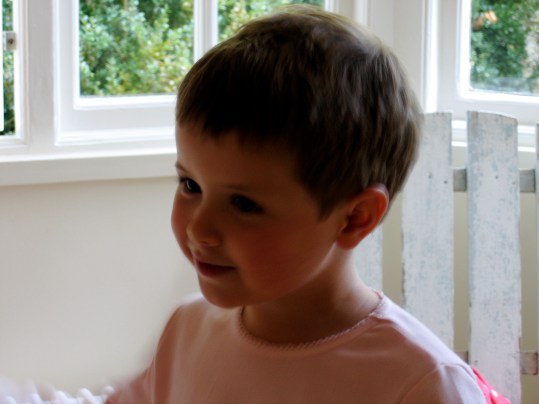
I elected to join a poetry class run by Paul Feldwick.  A group of us descended on Buxted Park in Sussex.  The hotel was a Fawlty Towers of inept but captivating staff, blundering about in a magical setting. I loved it.  We wrote our hands off when not staring out at  distant trees.  At one point, Paul encouraged us to try and capture the passing of time.   That year, Alice was approaching her third birthday.

Non-stopping.

You're coming up on three 
And it's coming up on me
It's going past a bit fast.

The second
To your brother's minute
The track you're speeding strangely known to me.
Familiar but snatched away.

Where I have stopped and dawdled once before
(You know the names: Firststeps, Firsttooth, Firstwords)
They have flickered by as barely made-out signs.
I've clattered on 
On the point of regardless.

You're coming up on three
And it's coming up on me
It's going past a bit fast.

These snatched snapshots -
Of course, I've filed the pictures
Convinced like every other gadget in the house
My photographic memory has gone digital.
"I'll savour your childhood at a later date."
No, it doesn't work for me either.

But it's funny, in a way.
On Saturday, we'll step down from the train
And feed the ducks for hours on end.
Settling in to the moment as a deep armchair
Your soup plate eyes sweeping me down.
However long we take
You will still be a second.
It will still be too short
And I will feel a sort
Of wondrous puzzlement.
You are particles accelerated
Faster than I can grab
This was a stab.

You're coming up on three
And it's coming up on me
It's going past a bit fast.


(18.9.2003)

Breakfast with teardrops.


Mike Tyson pushed past me, through the crowd, as I stood trying to buy a drink at the pool bar. His entourage surfed his wake. A youthful Robert Downey Junior looked nervous and sweaty as he waited for a cab in front of us.  The Mondrian Hotel on Sunset Boulevard carried on being, well, very Los Angeles in its 1990s way.

We were away for a week,  filming a Levi’s ad in South Central. (During an earthquake, at a corner store, four guys would be shaken out their floppy jeans outside whilst our hero’s rigid 501s stayed upright inside, despite the tremors, to the approval of a rather fabulous heroine.)  I was copywriter to the graceful Rosie Arnold. Our producer was Philippa Crane. The director was Doug Liman. As we filmed, he was busy prepping a movie that had just been green lit.  Stupidly, we didn’t really ask about it. His lead turned out to be Matt Damon. The movie, The Bourne Ultimatum.

Back in the UK, we wound up in a music studio just north of Regent’s Park with some of the most talented reggae musicians ever. They re-recorded  Prince Buster’s filthy ‘Whine or Grine’, with Prince Buster himself.  One of the more memorable evenings of my advertising life where Rosie played conductor with an elegance and sparkle all her own. In the end, when aired, it wasn’t the best Levi’s commercial, but it was a blast to make.

The whole project was overshadowed by a huge event that had engulfed the world. Just down from us on Sunset Boulevard, Hollywood inhabitants were lining up in droves, queuing patiently to record their feelings in carefully written tributes.

Princess Diana had died two weeks previously. Her actual funeral happened while we were in Los Angeles. We watched the event, through the night, on our hotel TVs. Like millions of others, I found it profoundly affecting: the sonorous bells; the silent crowds; her brother’s angry speech; the flowers thrown the length of the hearse’s journey to her final resting place. The national sense of tragic occasion was like no other experienced in my lifetime, except possibly Churchill’s funeral when I was an infant (and the broadcast was in black and white).  In the saddest way possible, the funeral was headache inducingly sombre, awful and cathartic.

The next morning, I sat down to breakfast outside, in the early morning sun, by the surreally calm pool and giant flower pots.  As I shovelled bacon and scrambled eggs about my plate, the waitress approached to pour coffee into my cup. I became aware of small drops of water raining down from above.

Looking up, I saw the tears streaming down her face.  She gave a muffled cry. “It’s so sad, I’m so sorry.”  Her distress was evident and real.  I’d never had anyone sob onto my breakfast before.

Minibus to Cairo.


rush-hour-cairo-egypt-58814846

We’d been presenting to the Egyptian Tourist Board.  It was very hot. We had pitched in a vast, basketball court of a hall in a government building.  A comedy of manners and errors, we held up our A3 scamp boards to the worthy dignitaries.  They were sitting at least twenty yards away.  Protocol dictated that we weren’t allowed to approach them. (Our urgent minder had insisted.) So we didn’t.

The television screen provided for our specimen video was firmly anchored to our table. A small domestic set, we might as well have presented a gold fish bowl to a passing cruise ship.  Our carefully plotted entreaties became pathetic shouts, disappearing  into the mute, sticky silence. The audience of officials betrayed no emotion. Not even pity. We slunk out at the end, not knowing whether to laugh or cry.

We set off – under the instructions of the tourist ministry – to view a holiday complex just outside Cairo city limits. Cramming into our minibus, we were driven to a series of smart, characterless, villa-style holiday homes. They were well made but, aside from the coarse couch grass and djellaba-style work wear of the groundsmen sweeping the immaculate pavements, we could have been in Marbella, or Montpelier or even Margate. After dutifully getting out to humour our driver by peering at a building or two, we crammed back into the minibus and set off for the airport. As we did, one of our number tuned in to a transistor radio, listening live to a broadcast from Trafalgar Square.

o2OR0sO

We could hear overly excited commentary, desperate to convey the anticipation and sense of atmosphere. Craning forward, we caught the drift of nerves and adrenaline sweeping London, seeping through as we sped towards Helliopolis and the flight home.

And then, at the appointed hour, came the sonorous, clipped announcement from whichever Euro-person had been designated: “The 2012 Olympics will be held in…London”.

Instantaneously, we were shouting. Fist pumping, smiling, hooting, we practically hugged each other. A moment of pure euphoria. We may well have banged the sides of the bus. From the transistor, London roared in ecstatic disbelief. That kind of thing…the UK wouldn’t win, couldn’t possibly win. But it had. We were going to host the Olympic Games. The. OLYMPIC. GAMES.   It was real.  Fact.  Happening. It was 6th July, 2007.

The following day was to bring terrible events to London, but for a few hours we flew home on a combination of British Airways and Cloud 9.

Infanticide.

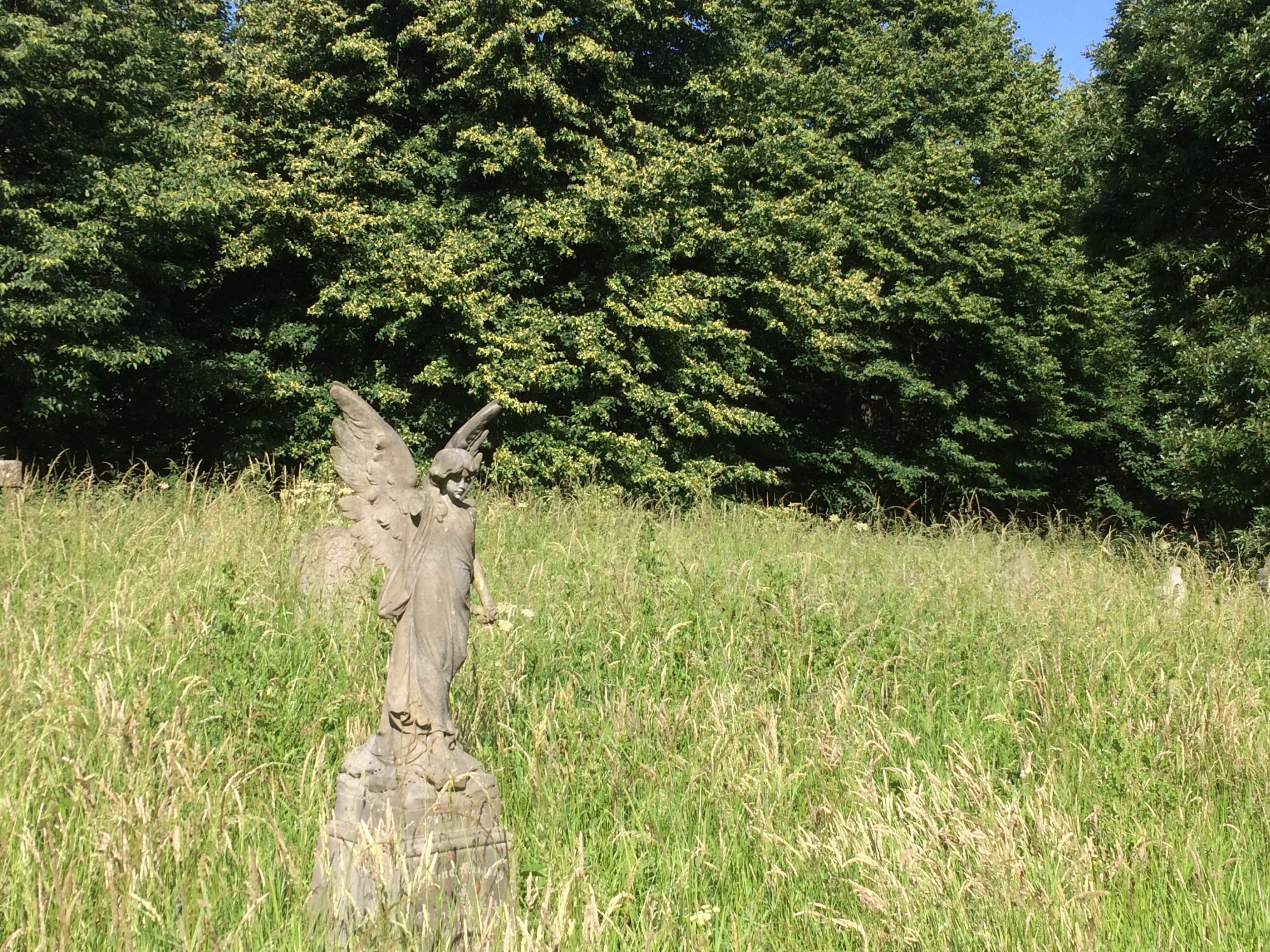
sunny graveI wish that I’d met John Murray. Instead, I have a copy of his commonplace book, the jottings of a lifetime captured by an inquisitive magpie of a publisher.  A feast of quotes, observations and snippets, it amounts to the most fabulous Loobrary book ever.

a-gentleman-publisher-s-commonplace-book_grande.jpg

In amongst the gems, one shines particularly for anyone engaged in the the business of coming up with ideas.  It’s the record of an exchange between two doctors in Vienna.  Factually, absolutely correct.

The first doctor:   “About the termination of pregnancy – I want your opinion. The father was syphilitic. The mother tuberculous. Of the children born, the first was blind, the second died, the third was deaf and dumb, the fourth was tuberculous. What would you have done?”

The second doctor: “I would have ended the next pregnancy.”

The first doctor: “Then you would have murdered Beethoven.”

The easiest thing in the world to kill is an idea.  Especially if all the precedents are less than positive.  Yet, with extraordinary frequency, so many great successes are born against a background of previous failure.

True, precious few advertising ideas amount to ‘a Beethoven’, but thousands of murders happen in agencies every day.  Creative directors kill the offspring of whirring minds in droves.  The business wouldn’t function if they didn’t.  The question that hovers, perennially, over this slaughter, is whether it is the right ideas that survive.  Countless bitter pints have been sunk in pubs by creative people whose work never made it out of the abattoir of their bosses’ office earlier that day.

I’ve personally killed off hundreds, probably thousands, of ideas.

I can’t say with any conviction that I have always spotted brilliance, separated it out and breathed life into its early form.  I’d be lying.  It takes true genius to identify the real winners at the start line.  And, like great composers, genius remains a commodity in desperately short supply.

Writers who don’t write.

IMG_9955

There are two kinds of writers. Those that write – and those that talk.

It might not be that they just talk. They could, for instance, chew pencils. They might make tea. They might arrange all the teaspoons in the draw so that they fit snugly into each other, an operation of such military precision and painstaking measurement, it can take hours. Some teaspoons are bit bigger than others so they need to be graded. It requires great patience.

The writers that don’t write do all sorts of other, very complicated things, not all them brilliantly. But of all the activities they’re not good at, writing is the one they excel at not being good at. They are gloriously, fabulously world-class at being really quite average. Beta males and females, they are, to a man and woman, woefully inadequate in focused, written communication. There are just too many distractions. Evidently, pens appear to these individuals as objects for laying down or, quite possibly, never picking up.

This blog is direct, personal evidence of just how ill accomplished these sort of people are. It’s absolutely true. They don’t write.

Yet, in a strange, oxymoronic, parallel universe, impossible-to-explain kind of a way, they sometimes manage to leave something behind. A trace. Somewhere between a smudge and a footprint, these ink droppings are for swooping in and peering at, a seagull’s snatched view rather than a long hard look.   In truth, the longer one looks at the scribblings, the less sense they make.

There. That’s my excuse for the random and extremely episodic nature of what’s captured here.  You have been warned.