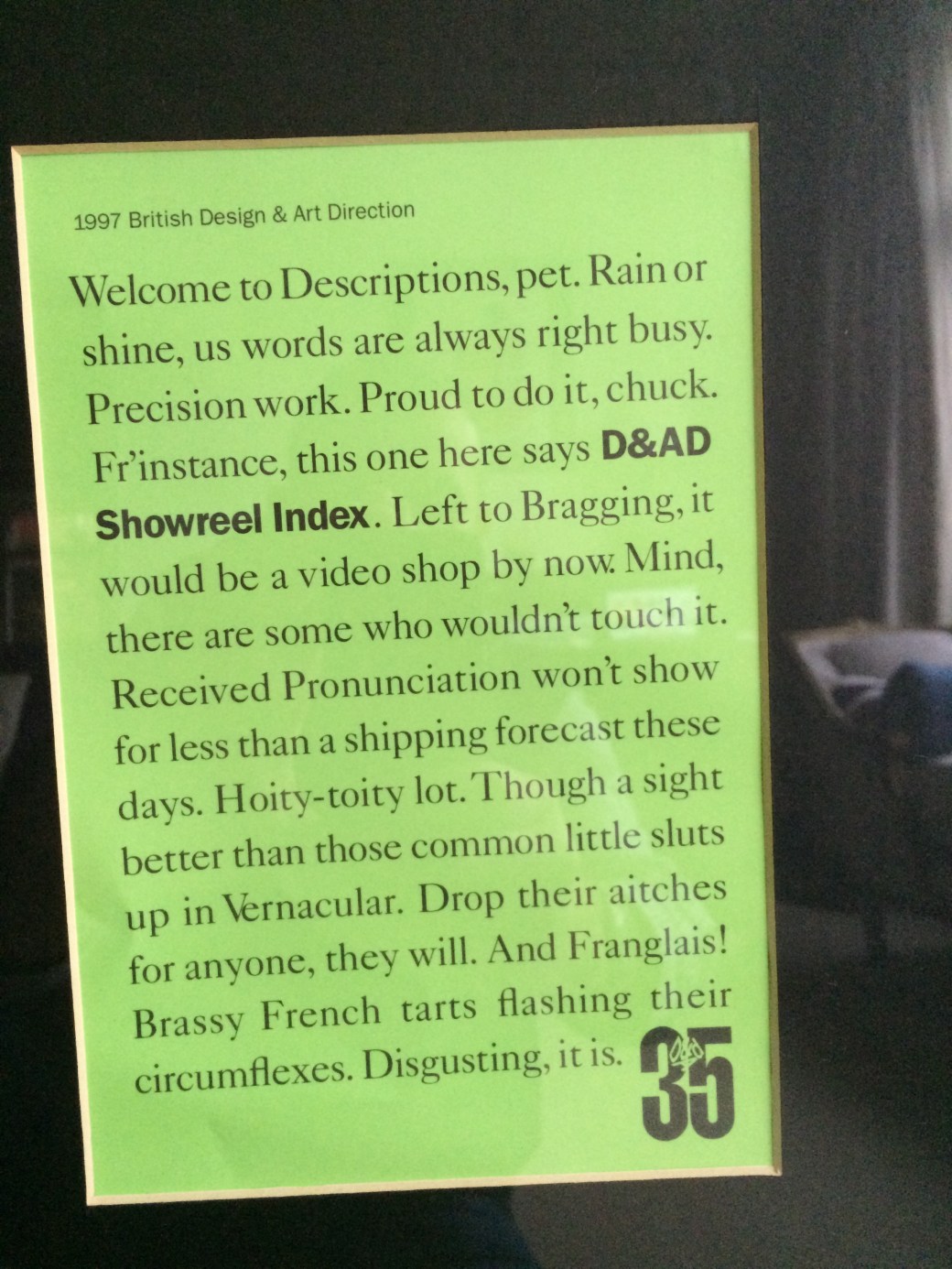
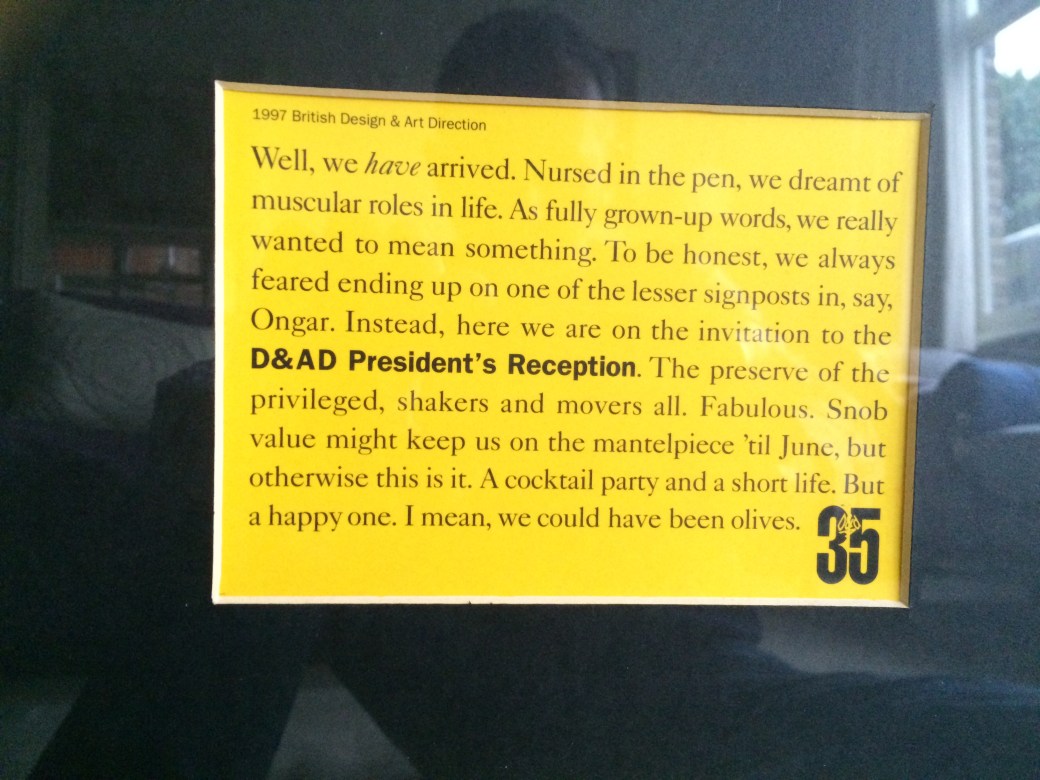
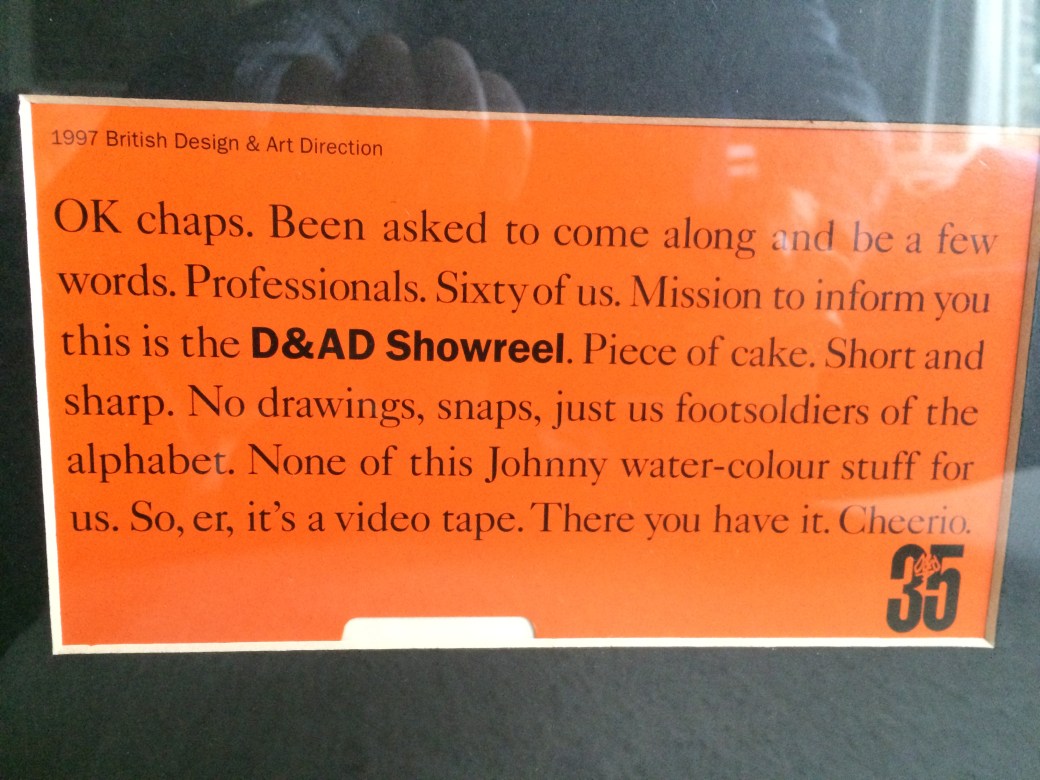
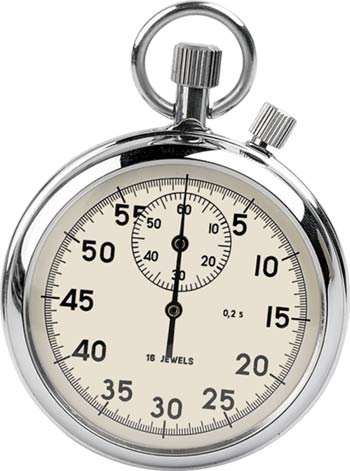
45 memorable seconds.

Stopwatch

Once upon a time, British TV commercials were 45 seconds long.

They were other time lengths too, but the 45 second TV ad was a very particular animal. A look at both Collett Dickinson Pearce’s work and also Alan Parker’s commercials supports this emphatically  (http://alanparker.com/earlywork/advertising-and-commercials/). It may well be the reason British advertising was so celebrated in the sunny 1970s.

Has there ever been a better vehicle in which to tell a story?

Forty-five seconds allows for the classic gag. The triptych with a payoff. The extended play with time for the rug pull. An Englishman, a Scotsman, a Welshman, a punch line and a pack shot. It all fits in three quarters of a minute. The timing is just so.

Perhaps it’s the British word count. Perhaps it’s simply that comic delivery demands those precious extra seconds. Perhaps it’s more than that.  Benson & Hedges cigars with George Cole, the Parker Pen Finishing School with Penelope Keith, Leonard Rossiter and Joan Collins Cinzano acts are all mini masterpieces.  Lego’s Kipper,  with actor Mike Reid impersonating Tommy Cooper on the voiceover, blocks its 45 seconds to absolute perfection.(You haven’t seen Kipper? https://www.youtube.com/watch?v=V2nL5sSSvd0)

Enjoyment, branding and memorable impact served up without truncation. Outstanding.

It’s not that there’s anything wrong with other time lengths, by the way. John Webster’s ‘Points of View’ is a peerless example of 30 second brilliance for The Guardian. And whatever the length, there’s no denying the importance of the idea, the talents of the writer, art director, director and cast and their contribution to how engaging the final concoction. It’s just that 45 seconds allows for more cultural play and richer character development. More profligate of budget, perhaps, but friendlier. More resonant.

According to some research company or other, the statistic back in 2006 was that a 35-year-old in Britain had watched 106 days of television advertisements. That’s 24 hours a day, seven days a week. Desperately trying to remember any of them would be hard enough. The layering and richness of 45 seconds would have edged many, if not most of the 30s. (In a different medium, in their era, the 45 triumphed over the 33rpm disc in terms of sales and mind space.  But that’s another story.)

There are classics of the 45-second era that show so many others more readily divisible by ten a clean set of heels. Broadcast media that, on its day and in the right hands, had the audience leaning forward, not sitting back. Yes, commercial telly had more of a monopoly then but yes, these were evidently loved into creation by careful minds with a beady eye on the second hand of the clock.

It’s not bacon.

IMG_0783

The diversionary family chapter came to something of a full stop on 14th March. My father’s ashes were interred at Hughenden church. His joined those of my mother, who died in 1990. We also tucked in the ashes of a much loved labrador, Jinja, who survived him by only a matter of days. On a bright, chilly morning, we placed both boxes into the neat space. As we listened to a stridently positive read of Psalm 139, a Red Kite flew overhead and up towards Hughenden Manor. My father, never particularly ornithological, always remarked upon Red Kites and their return to the Chilterns.

I chatted to the psalm reader, the splendid sacristan Arthur, who is to Hughenden church as ravens to the Tower of London. Dickensian in appearance, he has been there forever, tending to the churchyard and the congregation with deliberation and mischievous wit. He was wistfully lamenting the loss of the two mowers-in-residence, Jacob sheep that used to live in the churchyard. They are now retired. He also pointed to where the oil tank had had to be moved. Burglars backed a truck up to it in its previous position alongside the churchyard wall a year ago and siphoned nearly 500 gallons of the stuff.

In these circumstances, loss couldn’t help but be something of a theme.

One can miss something to the point of great anguish. What we want most is often what we simply can’t have. Loss is an extraordinary force. Deprivation is a powerful weapon. Being denied something – water, money, a comfy place in the hammock – makes it all the more appealing. Desperately, we crave. We long. Mournfully, we ache for hot, buttered toast on cold, miserable touchlines.

Back in my day job, I ran another Writing For Advertising session for British Design and Art Direction in February. I set the 15 attendees a task to try and sell bacon to a public increasingly under siege about its dangers.

As yet another report has highlighted, there are strong links between eating processed meat and the risk of heart attacks, bowel cancer and strokes. “Processed meats, including bacon, sausages, parma ham, cooked ham and salami, have a very high salt content and the act of processing itself is associated with an increase of heart disease, bowel cancer and stroke,” says one Dr Michael Mosley. “One esteemed scientist I know called Dr David Spiegelhalter told me that if you crunch the numbers, every bacon sandwich you eat knocks half an hour off your life.”

The exam question I set the D&AD group was to make people want to eat bacon. They had 25 minutes to develop a campaign. The rules said it had to work in more than one media.

Hands down winner came from a team of three women. Either literally, in an ambient setting like a station concourse, or in a TV spot, mum-like figures would offer passers-by or breakfasting families something from a frying pan. It might be to go between two slices of deliciously hot toast, or to accompany a fried egg. Using tongs, on offer would be celery sticks, lettuce leaves or whole carrots, soggy from the heat. The campaign would be clearly signed off, “It’s not bacon”.

Something about the association of hot, crisp, salted meat with the idea of breakfast and then its absurd absence as star attraction sells it so much more powerfully. It certainly made me want to eat a bit of streaky there and then.

It’s a considerable leap from a graveside to a bacon sandwich. The watchword here is not to appear grotesque. But, as a way of capturing life in the post Richard Awdry era, there was something my dad added to the everyday, a salty vim to how he observed life, commented (incessantly) upon it and made more vividly enjoyable when he was here.

In other words, whatever a day is without Richard Awdry in it, it’s just not bacon.

100 Pictures of my Father.

Flat window.

I’m not sure if the following are memories or impressions. Perhaps they’re best described as snapshots. I have inherited his lack of historical accuracy.

* * *

Leaning back, side by side with my mother, with his hand on the tiller of a small sailing boat as they skimmed about on a sunny evening on our Norfolk Broads holiday. We four children were watching from our rented motorboat. In that moment, they were a smiling, glamorous couple and he looked so dashing.

* * *

Clambering on to his lap, when I was three or four, to secure some after bedtime television viewing, in drawing room. The mock disapproval of my mother helped to fuel the complicity of it.

* * *

One evening in the bathroom, teaching me to tie a bow in my dressing gown cord. “Nearly. Half a sec. There, try it again.” He taught me so well that I ‘got’ it and never had to ask again.

* * *

The One-Armed Flautist joke, told to our shrieks of delight and my mother’s giggling, mock embarrassment, in the kitchen at Little Downham. His face pivoted between the raconteur of the joke and the fluttery features of the musician.

* * *

Massaging a bloodied chin after a laurel bough had sprung back and walloped him as he cut the hedge, He sat, bleeding into bits of hanky at the kitchen table on a hot summer’s afternoon. Two hours later, he relented and went off to Casualty for a stitch.

* * *

My sheer embarrassment at the counter of Lloyds Bank in Great Portland Street as he introduced my 17-year-old self not just to the teller, but also to the waiting customers and all the other staff. He knew them all. Or so it seemed.

* * *

Holding the service sheets on his lap, his hands white and tense, as he sat next to me in the passenger seat as we drove to my mother’s funeral. We had had to turn in to Equity & Law’s approach road to go back and pick them up.

* * *

Meeting him and my mother, by accident, shopping in St Pourçain as they were heading to pick me up from my French exchange. He quickly told me of the parrot, the TV and the one night (only) that he and my mother had spent in a tent on their ‘Camping Trip’. His face scrunched up and practically crying with laughter.

* * *

His morning face, as he handed over a cup of tea and over enunciated the ‘T’ in Happy Christmas with a ringing, kindly sincerity.

* * *

Mulling on Boxing Day in the kitchen of the granny flat. A distinctive smell of gas combined with the richly alcoholic, clove-y fumes of Don Cortez Spanish red. He radiated eager concentration to get it right.

* * *

As my bowled ball tipped the bails of Father Number Ten, my father – at number eleven – saying “Oh, I hoped you’d keep that one away from him” from the crease next to me. He didn’t have the chance to face a ball and walked of good-naturedly.

* * *

Twenty minutes later, in a postscript match on the square at St Neot’s, his scoring an easy six with my white, composite cricket bat, topping twenty in the same stroke and walking heroically off the field to hand it to the next player. A cricket God.

* * *

A tobacco tin, red, with the distinctive Players’ typography, on his desk on a bright morning in ‘The Flat’ at Little Downham. Setting, object, context: unmistakably, completely, my father’s.

* * *

The green jumper. Hand-knitted, held together with who-knows-what determination. Umpteen family holiday’s worth. And then some.

* * *

The pointing, second finger, jauntily extended in to the air of his later years. “Hey Buddy”, the accompanying cry.

* * *

His throw-your-head back projection as he read The Specialist to us one mealtime in an unrelenting Australian accent. “Aaftah thet, she jest hollered.”

* * *

After Brie, the Labrador’s, run–over accident, I was left at the back of Wycombe station to meet him while the dog was in the vet’s. Wearing just a T-shirt, I remember meeting my father and our coming home on the bus, his draping his see-thru plastic Mac on my shoulders to try and warm me up. The slightly bewildered look on his face.

* * *

My father peering gloomily at the chips I’d made in the overflow drain at the edge of the pond to alleviate frogspawn and weed build up. His suggested – very gently – that the water level would simply sink. In an aberration of basic physics, I hadn’t spotted that.

* * *

Telling me, at another Father’s cricket match at St Neot’s, about how he was convinced that Brie was expecting puppies because, “Her buttons are so pink”. He meant nipples. About as close to sex education as I ever got from him.

* * *

My father stepped out of nowhere from behind me to pay the charge for my postal order in Hazelmere post office. I had saved up with exactly the right amount for the chemistry set additions but had not a penny more. I hadn’t realized one, that it cost and two, he was watching over me.

* * *

That extraordinarily clear and resonant voice as he read a lesson for John Olhausen’s Matins.

* * *

He paused and watched three girls dancing in unison to Mud’s Tiger Feet at a Hazlemere C of E school summer event in the dusk. We were leaving to go home. “I think,” he said, “I understand pop music for the first time.”

* * *

The bellow we heard when he caught a two pound Rass on a line and shrieked “Jocelyn” as he landed it. I think we were in Ireland. You could have heard the cry in Wales.

* * *

Taking Angus Kendall and I to watch the Proteas rugby team play in Aylesbury. While the Africans looked miserable, trying to cope with a greasy ball and sub zero temperatures, he tried to overcome our juddery, freezing torpor with good humor.

* * *

The sharp hiss, an indrawn gasp of air through the rictus of a false smile whenever any other driver than he was at the wheel of the family car. Usually accompanied by his clenching the armrest of the door handle.

* * *

Helping himself absent-mindedly to a Punch magazine or two from the stack in my wardrobe. A serum to the anxiety in the house as my mother was gravely ill.

* * *

Lying in the bath and grunting with the perfect, onomatopoeic response to a hard weekend’s gardening. I knew exactly what he felt and meant.

* * *

On holiday, he stopped to pick up an old and unfortunate woman with a tennis ball-sized growth on her forehead, inflicting her on the four of us in the back of the white Cortina estate. Loudly and artificially, he kept a conversation going with our mother about the number of Magpies they observed that morning as we drove along the Mealagh Valley to Bantry. We were frozen with awkwardness.

* * *

Walking back in through the back gate at Little Downham with a great branch on his shoulder for the fire. Countless times.

* * *

Talking about Hemingway’s ‘The Light of the World’, Ring Lardner’s ‘Haircut’ and Jack Schaeffer’s ‘Shane’ with reverential awe.

* * *

The surprising sprint across the front lawn (a grass tennis court) as he walked in from work to kick a football that Matthew Orr and I were playing with. Probably aged 42, he met my incredulity with, “I was playing football long before you were born.” Up to that point, I’d never realized.

* * *

Polishing off the last centimetre of Martini Rosé in a smoked glass tumbler from the Esso garage with a satisfied gulp. For a time, the aperitif of choice in the Awdry household.

* * *

The ring of the black typewriter as the manual carriage returned. A crystalline, sonic indication of “man at work”.

* * *

The acrid smell of Swan Vesta matches in the downstairs loo as the gonks on the wallpaper looked on at you. He’d ‘been’.

* * *

Walking into a shop in rainy Cornwall (Camelford holiday) and declaring to the shopkeeper we were about half a ton of direct descendants. He varied the delivery on this particular line ever after.

* * *

Always referring to his sibling as ‘Phillip, my brother’.

* * *

Giving me sixpence pocket money on a Friday night at the Werner’s in Kent, so that, for the first time, I had a whole pound. He watched me closely as I took it.

* * *

Digging my little garden for me with his big fork by the dip one Saturday morning, even though he had a terrible headache.

* * *

Kneeling, in striped pyjamas, to say his prayers before bed. I was probably sixteen.

* * *

Watching him laugh and laugh his face into helplessness, for the sheer joy of family, sitting together, at the kitchen table, on a weekend afternoon. It didn’t really matter how it started. (Although it was usually because somebody had blown off).

* * *

Walking across a field to right a sheep as I clung to his shoulders, peering down at the grass lurching at his feet. He walked me into the bough of a tree, observed by the rest of family waiting in the green Morris.

* * *

Standing in the flickering green of a Welsh wood in August, watching an otter cross a dam in a small stream, fast flowing and perfect, as I stood beside him.

* * *

Listening to 100 Best Tunes, presented by Alan Keith, in the bath on a Sunday night.

* * *

Endless, endless patience as we walked up and down Oxford Street until he stood me to my final choice of a pair of stout, mustard-coloured shoes. They were repellent but he humoured me.

* * *

Driving through the dark of Marlow on the way back to prep school, he told me of a WWII pilot who’d fallen thousands of feet with an air vest and no parachute. The airman had blown up the air vest, which re-floated him in time to survive despite breaking his legs on impact with the sea. Later he spoke of planes stuffed with ping-pong balls to keep them afloat if shot down, during the same school journeys.

* * *

The way he stroked a dog – part pat, part reassuring thump – an exact and particular communion of great reassurance.

* * *

Watching him in a red check shirt and white shorts freewheel down the mountain road in front of me on a cycle ride to the unimpressive temple on top of Poros. The day itself hot and resiny, as we rode.

* * *

My father saying slowly and deliberately ‘Por Fah Vor’ to Spaniards on the dock as I got into snorkelling difficulty in the bay at Tamariu. They kindly helped me out of the water.

* * *

At the back of Wycombe station, watching the moment he detached from being one of the army of tired, smoky commuters and became my father about to join us in our car. (My mother said, at just such a time, “He still makes my heart skip.”)

* * *

Chatting to the bus conductors and drivers on the brightly lit lower deck of the bus, whom he knew by name so they would drop him outside the gate.

* * *

Coming to see me as third spear-carrier – or whatever – in restoration drama Women Beware Women in the Oxford Playhouse. And sleeping throughout.

* * *

Snorting into a small plastic watering can to mimic the sound of a pig. Remarkably effective.

* * *

That red-eyed, coming-up-from-the-depths moment as he woke up after a Sunday sleep, the forehead stretch, triple blink and slight grimace as he adjusted his features. This series of facial manoeuvres always followed by the declamation, “Cuppa tea?”

* * *

With my mother, in the audience, at Mrs Housemann’s nursery when I was Joseph in the nativity play. Not being able to meet his steady, loving gaze as I gurned with a hopeless grin of first-ever stage fright.

* * *

The way he would say, for instance, “And one for his knob is sev-en,” in a cribbage game, giving a little sing-song note to the last consonant.

* * *

Standing proudly tall, with his brother, on a Breton beach playing petanque.

* * *

Collapsing on the grass by the brown Vauxhall on a French verge as he and John Mercer desperately tried to get some sleep after an all-night drive from Cherbourg to (pretty much) Poitiers.

* * *

On a package holiday, singing ‘Green-Grow-The-Rushes-Oh’ at top volume in the Muribus in Spain, having taught the Muribirds Jan and Sally and the Muri-boyfriend driver the words.

* * *

Socially accommodating a garage mechanic in front of the whole family by saying “Ta” and looking hunted as we taunted him for it. My mother’s mock shame and his indignant guilt.

* * *

Proudly walking me round the orchard at the bottom of Beaconwood and showing each tree as we wandered.

* * *

Managing to communicate to the manager and manageress of La Mura in Mel, Belluno who became embroiled in the party spirit, handing out bottles of wine and being seduced by the Richard Awdry charm as a result. A performance of persistent, energetic enthusiasm.

* * *

Prodding the Harissa on his plate in a pub near Ross on Wye when we went for a father/son weekend early in his marriage to Gill. He was very suspicious of it.

* * *

Trying to sleep in the cabin of the Fishguard/Cork Ferry as I stood and peered out of the porthole during our approach. He didn’t lose his temper but he could have easily. I was seven or eight.

* * *

His engaged but actually quite relaxed style as we drove at 80 mph for hours on end, across endless northern French motorways en route to the ferry. A driver in a groove, on a mission, happy in his concentration.

* * *

Walking towards me and Andrea with John Mercer, as we waited on the pavement to greet him and take him to see Peter Ustinov as a fillip shortly after Ma died. At that point, he was heartbreakingly alone and it was so good to watch him laugh.

* * *

Leaning over the old wheelbarrow, with Glanville, the gardener’s, wooden extension ‘lip’, pouring grass mowings from the Atco mower into its depths, surrounded by that jolt of a scent of fresh cut grass. A picture of summer in a checked Clydella shirt.

* * *

A catch phrase, often repeated, with a little tweak of the eyebrows: “Morning squire. Thwack. Thank ‘ee Squire. Thwack.”.

* * *

Standing looking down at all the plastic cowboys and Indians on a scrunched up rug in the attic room. “Extraordinary, all this. To think that all we had was a lot of old lead. Nothing like this…”

* * *

Playing Consequences and watching his face when his contribution to the ‘She was wearing’ caption was read out. His suggestion? “Even less.”

* * *

Mimicking the builder who drove a pony and trap onto Rooska Bay, saying ‘Collecting thand for plaathdur’ over and over again until our mother said: “Stop it. You’re making me want to go to the loo.”

* * *

The single raised finger above the driving wheel that was his way of thanking the on-coming driver.

* * *

Driving the outboard motor boat up the channel between Corfu and Albania with my mother and younger sister on board.

* * *

Lying hopelessly in bed with a carbuncle on his waist, my first conscious experience of a grown-up in bed ill. He drank lots of lemon barley water.

* * *

Standing gravely outside Charles Griffin’s front door with a full Native American headdress on, above his tweed jacket. Incongruous.

* * *

Drying up, cloth in hand, as I washed and the family sat round, he sang “He was her ma-aaan, and he was doing her wrong. Rooty toot too, three times she shoot, right through the cupboard door”, before going on to make muted trumpet noises as he waltzed about by the boiler.

* * *

Head in hands, at the table, trying to work out how to pay the school fees and a look of hung-dog despair lining the crevices of his face.

* * *

“Wine for my men. We ride at dawn.” Spoken with conspiratorial passion at the supper table, a touch of frontier bravado, red in tooth and claw, imparted from his shining eyes. Suburban Buckinghamshire suddenly very far away.

* * *

Making a complete hash (itself one of his stock phrases) of programming the video in the early days of Beaconwood. Whatever was supposed to happen was clearly never going to happen. In the ensuing melt down, he managed to get four syllables out of “Oh Dee-yer-ahhh” as opposed to his normal three.

* * *

Standing at the King William IV pub, newly married to Gill, as bashful and hopeless as a 14 year old but with absolute delight in his eyes.

* * *

The snort. A sometimes troubling, always unexpected event, much like a blue whale’s blow hole in action. As characteristic a sound as you could imagine.

* * *

Making a bra out of a linen napkin in the course of a long and elaborate joke at the table again. An extraordinary, origami-like achievement. We children were enthralled.

* * *

The look of anguish when I cheerfully suggested at Delaware, in front of the venerable Mrs. Hole (then in her eighties) that my father would be found on the dockside in Yarmouth the following morning ‘absolutely sloshed’. He was to go to a boat club dinner and we were taking the ferry the next morning to pick him up en route to our summer holiday. In the event, he just looked awfully hung-over.

* * *

The assured way he was painting the back of a strip of wallpaper in the wisteria room as he redecorated. As professional an act as I have ever seen.

* * *

Walking as solemn as a vicar round the garden with a shovel full of dog poo as he flung it into the hedge. The duties carried out with comic dignity.

* * *

The necessary brutality in his face as he came in from dispatching kittens, not able to acknowledge my childish incomprehension as I stood at the boiler. A lesson unappreciated at the time.

* * *

Watching his (two) typing fingers thump out Glenn Miller’s ‘In The Mood’ for me to follow. I still play it his way to this day.

* * *

On the real tennis court at Merton with his brother, gamely battling on whilst being bamboozled by the likes of an ‘American Railroad Service’. The rules sounded as if they were under construction in Uncle Phil’s head.

* * *

Shaving one bright sunny morning at his bedroom sink as Emma and I sat by the electric fire in the parents’ bedroom. “I have something to tell you,” he said. It was a Saturday morning. “Aunt Bee has died”.

* * *

Watching him as we sat in a bar after Julian and Sue’s wedding, where he smoked two or three cigarettes, as pipes were not allowed.

* * *

“Moses rent his garments and showed his great concern.” That steeple- eye-browed pious look to accompany an oft-quoted gem of innuendo.

* * *

Tanned, with sleeves rolled up, doing the paper balls trick to Mik and Louise Brown’s kids with effortless confidence. An unassailable performance.

* * *

Sitting by a gravel pit lake, in Gloucestershire, on a chilly October afternoon, laughing at the memory of Tony Poole and also his own father, in hysterics without having to say barely a word.

* * *

His green flecked eyes, an extraordinary mix of hues and colours, pausing for thought, crinkled with amusement.

* * *

Sitting on the terrace outside Beaconwood, when meeting John and Daphne Marshall for the first time, and asking, “Shall we reveal our secrets?” as he produced his pipe from his pocket.

* * *

Looking down at his brown legs on Nissaki ‘Beach’ in Corfu and saying, “It’s so exciting to have hair growing on my ankles again.”

* * *

The one word acknowledgement reply: “Rather.” “Very.” “Tremendous”.

* * *

“Gilly. Gilly. Here.” Only ever a mental image as it signified him busy offloading the phone receiver to Gill to ‘do’ detail. As the instrument in his hands was suddenly buzzing with unanswerable questions.

* * *

Sitting, large-tummied, in post-operative delicacy in a pink armchair at Beaconwood. As though perched on an eggshell of good fortune, not quite ready to discuss the enormity of his aneurism op.

* * *

Biting his lip with patient indulgence as he endured Roy Cross’ monotone, when the cleaner’s son fitted our lobby cupboards whilst telling, droning stories, each as dismally dull as the last.

* * *

Giving a theatrical ralentando when talking to our mother and saying, “Oh, you baggage” with deep affection.

* * *

The shape of his face as he would say:
“N-kuuuuu-duuuuuh”, my phonetic take on his word for a distant dove in (I think) Chineangian, from days with either the Somaliland scouts or tea planting.

* * *

“Hello Father,” his attentive greeting to Grandad on the lawn as they walked up and down at the Forge, talking of this and that.

* * *

His split thumbs in wet wintertime. A jagged battlefield of domestic chores meeting the British climate with obvious consequences.

* * *

The speech he gave at Johanna’s wedding with the joke he’d written on the dog walk. His happy face as he projected the good news about marrying a rower preparing her for life: Endless grind, can’t see where you’re going and, unless somebody’s pulling strings, you’re going to have some difficulty with the bank

* * *
We’ve lost a library.

Richard Awdry001 (2)Richard Charles Visger Awdry would settle happily for the word, “Writer” to describe his occupation in his passport. He wrote volumes. Thinking of him as a published work, The Book Of Richard itself is 85 years long and a fabulous read.

From the cover alone, there were the big cheekbones; green/brown eyes; thick, leonine, brushed-back hair. A face creased from smiling. Hands that would part stroke, part thump the dogs with affection, often with split thumbs in winter. But rather than judge him by the cover, there were many, many chapters to his name.

Christmas Day baby. Chippenham infant. Cleveden schoolboy. Evacuee. Geelong Grammar School student. Sheep station hand. Marlburian. 2nd Lieutenant, Somaliland Scouts. Agricultural student. Farmer. Tea planter. London stage writer. Author. Advertising copywriter. Churchman. World Traveller. Gardener. Golfer. Raconteur. Pipe smoker. Labrador man. Clattery typist. Cricket lover. Incessant reader. Fellow well met.

Dutiful son. Happy Brother and Uncle. Charismatic Father, Stepfather and Grandfather.

And honestly, above all, both the loving and loved husband of two remarkable women in two, remarkable marriages.

Richard was an irrepressible force of nature. With clay feet, he kept his gaze on the stars or, more likely, some obscure story he’d just discovered and would repeat to the next person he met. Everybody who Richard encountered became swept up in a world of stories. They weren’t always told the same way, but they were inexhaustible.

Born to an unassuming country solicitor and his strong-willed wife, early life was St Mary Street in Chippenham. At prep school in Cleveden, Somerset, escaping German bombers ditched their 500 lb bombs destined for Bristol on the playing fields which slithered towards the goalposts but miraculously did not go off. The boys were fascinated.

As the war dragged on, his parents evacuated him to Australia with his brother Philip. He loved it. Looked after by Aunt Katie on the sheep station near Corrawa, he developed a view of farming both pragmatic and poetic. Aunt Katie kindled his passion for the Old Testament, reading him passages every night. His affection for the Sargood family never dimmed and he returned with Gill in later life, connecting with subsequent generations. At Geelong, in the same class as Rupert Murdoch (Richard loved dropping names), a passion for literature ignited.

Back in England at Marlborough College, he was the fifth generation of Awdrys to attend. He used his time wisely. It shaped his view of society and friendships forever. He loved Old Marlburian days and catching up with contemporaries, if only to check how much older than him they looked. Instinctively – and at some cost – he sent his four children to the school too.

National Service in the Wiltshire regiment took him, eventually, to the Somaliland Scouts in the Horn of Africa. A lieutenant and peacekeeper, he was granted a huge constituency, a string of Polo ponies and a fund of deeply improbable stories.

In England again, he attended Cirencester Agricultural College, his mind set (he thought) on farming. The most exciting distraction was to appear in the shape of Jocelyn Poole, the daughter of local and colourful parents in Coates. She was a beautiful singer and one time secretary to the Third Programme at the BBC. Swept off their feet in the giddy post war climate, the glamorous couple married in 1952, both aged 22. It was a marriage that was to last 37 happy years of absolute, mutual dependency.

From Cirencester, he scurried off to become a tea planter on Mount Melangi, in what was Nyasaland. Jocelyn followed a few months later. For two years, they lived a charmed existence, thrilled by Africa, Africans and a curiosity of friends. Amanda, their first born, arrived in the local hospital. Using the very expensive phone to tell Philip, his brother, the news back in England, Richard mentioned Amanda’s name and sex and not much else, instead jumping to unseemly jokes to our mother’s exasperation.

Returning first to Essex, then London, Richard got a job in advertising. Populated by lively minds from all walks of life, it was a world made for him. He wrote a review for the stage called Take To The Hills that was produced with Hughie Green and Gerald Harper in starring roles. He published a thinly veiled account of family eccentricities as a novel called A Pride Of Relations. (Radio 4 revisited it as book of the week about 10 years ago.) He also created a number of short stories, published in Argosy and other magazines, a habit he continued right up to a few months ago. And, two years after Amanda, Julian was born to join the family in the little Wandsworth house.

Richard stuck with advertising through the Sixties and Seventies, finally spending 10 years penning an agricultural digest as “Walter Strong”. The family moved to the Chilterns. William was born in 1961, Emma 1963 – the Hamiltons – growing up with Amanda and Julian in Little Downham, the draughty Victorian home for nearly 30 years.

When Jocelyn became ill with cancer from a melanoma in 1988, Richard took on the role of stalwart supporter. Over two, difficult years, he was unfussily dependable. He would set off ‘up the village’ with a wicker basket on his arm to do the necessary shopping.

Reeling from Jocelyn’s death in 1990, he met Gill – then a Coles – who had suffered the same terrible loss with her wonderful David. It was actually at a bereavement bash organised through the Church that they came across each other. Richard had the four grown-up children; Gill two in the shape of Philip and Richard.

They were married in June 1991 in Buckinghamshire. An alliance that was mutually supportive, clearly – to the rest of us – developed into something far more loving very quickly. Together, he and Gill set about creating a new home in Beaconwood and a life that included their combined six children and any other appendages already in place or that that hove into view. They worked at forging bonds with family and with friends new and old. Beaconwood was seldom theirs alone for more than a day or two.

Their joy in life and the genuine excitement of what lay around the corner was palpable and remained so. They went to Africa and the old haunts, to America, Australia, all points in between, some of them on ships. Gill helped Richard enormously, a life support machine when he needed one (not that he’d ever admit it) who tolerated his peculiarities, encouraged his enthusiasms, gave him license to address any and everybody he met, which seemed to be a growing, rather than reducing, number.

Of course, there were the odd fiery moments, more often than not occasioned by events in the family. In choppy seas, the Richard and Gill alliance remained a Fastnet Rock of continuity over 24-and-a-half years. It was a joy to see how happy they could make each other, although they weren’t beyond winding each other up something rotten every now and then. Richard was very human.

He loved Gill’s two boys. When Philip was considering particularly big decisions in his life, Richard – perhaps uncharacteristically for him – actually listened hard and ventured useful advice. To Ritchie, he provided both a constant and also a sounding board, talking over the steps of his life, one of the biggest being the jump to Australia.

To his four children, he remained an inspirational father. For instance, Julian, living in Oregon, wrote to him last year saying:

“You gave a small boy the courage and the confidence to go out and explore the world, to try and tread where his father had trod, and to venture to places where there were no footprints to follow. I always wanted to come home, and to be able to share that with you; and to catch the warmth of your smile and the touch of your hand.”

During the last years in Poole Keynes and Kemble, Richard plunged in to local life with his customary enthusiasm. He was a great chatterer. The many wonderful cards from local people following his death stand as tribute to his enviable sociability. Having attended him through two complicated aneurism operations, neither a walk in the park, Gill’s observation strikes as particularly apposite. “He wasn’t frightened of dying but he loved living”, she said.

He himself was delighted by an African proverb he found in a copy of The Week. “When an old man dies, a library burns down.” What a library to have have lost.

Richard Awdry: Who observed with an artist’s eye and wrote with a writer’s pen.

Richard Awdry: A gentleman who was loved and was loving.

Richard Awdry: Whose philosophy of life was perhaps best captured in the very last line of his book, A Pride Of Relations:

“Everyone … has some kind of importance.”

Richard Charles Visger Awdry:  25.12.1929 – 27.12.2014

French justice.

70865173

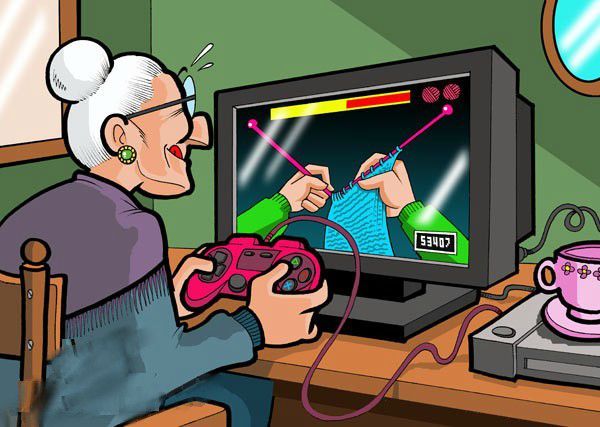
I have always been haunted by Les Tricoteuses.  My eight year-old self was fascinated by the ladies, knitting savagely, as beside them head after head fell into the basket of history’s most famous decapitator.  I even projected the voices and personalities of my mum’s friends from our very English village into the tableau.  “Ooooh, look at him. Guilty little aristocrat….Oh well, another day, another neck. Knit one, pearl one, all the same to me…”  I imagined they’d coo and mutter as the Guillotine chopped its way through the Revolution, much like a WI group or a Tupperware party.

The notion of guilt is what stuck with me.  The assumption that the aristocracy was just, well, guilty was a strange one. I pondered the acceptance that an entire class were criminally culpable  – of wealth, stupidity, cooking fish the wrong way – and deserved to be killed.  And while they lost their heads, the women, a microcosm of broad society, watched events and stuck to their knitting.

Perhaps, in a complicated, Gallic way, it bred a later tolerance for public figures guilty of horrible private habits. Slight shrug, eye roll, leave your dirty laundry at the Parliamentary chamber door, Mr President.  Only recently – over Strauss Kahn particularly – has there been a wake up to the private restraint/public morality thing, so beloved of British red tops when they had teeth. The mood is shifting, but the law isn’t.

In France, you are guilty until proved innocent.

The opposite of the UK, French justice is a perfect analogy for marketing.  Whereas we used to trust brands like  Bobbies on bicycles,  rivers of powered baby milk scandals, apartheid bankers, food scares, epidemics, vehicle recalls and epic product fails have washed away our blithe acceptance.  Even agnosticism is rare, replaced by disinterest, suspicion or outright rejection. Brands are convicted in record time. Consumers, playing judge, jury and executioner, tell your precious little plaintiff it’s going to be taken from here to a place of execution and may God have mercy on its soul. No appeal.

Of course, we all reject stuff for many more reasons than it’s simply guilty.  But the notion is useful.  People build relationships with brands through repeated, positive, personal experience. They gather enough evidence to be convinced the brand is ‘clean’.  Somebody, somewhere, is probably shouting that Toilet Duck Is Innocent even now.

I was always struck by an observation Andy Knowles of JKR made in about 2006. That year, the average UK shopping basket was 57 items.  At the same time, the average offering across the Big Six multiples – Tesco, Sainsbury, Asda, Waitrose, Safeway and Morrisons- was a convenient 30,000.  (This was before each had invaded the High Street with ‘Local’ branch thinking.)  As Andy pointed out, the typical shopper was walking into the typical sized supermarket and immediately rejecting 29, 943 items just like that.  Most, for sure, because they were irrelevant. Many, in addition, because they were guilty.

It’s why I find the idea of Parole so powerful. Brands make their way through the landscape under surveillance, a hair’s breadth from being taken into custody for questionable behaviour.  While bland and safe isn’t going to get you anywhere, your particular schtick of quirky, charismatic individuality had better be honest and true, or you’re going down. Fast.

It throws an enormous responsibility onto the language you use and the vocabulary you select.  As if it wasn’t bleeding obvious in the first place, more than ever marketers have to live with the fact that your word is your brand.

I see your point.

John F Kennedy Marylyn

When writing commercial messages, the phrase ‘Seeing is believing’ rings emphatically true. People who write in pictograms transmit their message so much more efficiently.  Whilst the late David Ogilvy thundered that, “70% of communication is visual”, words alone can fuel potent, pictorial ideas.

In politics, they say you campaign in poetry and govern in prose.  To which I’d add, you’re remembered in pictures.  Think of Thatcher, Blair, Clinton or Nixon.  First memories that bubble up are nearly always an image.   Winston Churchill, on speechwriting, delivered a 17 word summary of what makes good writing in any sphere: “Begin strongly; Have one theme; Use simple language; Leave a picture in the listener’s mind; End dramatically.” A master of language, he knew the value of the visual.

I remember reading a powerful critique of US President’s inaugural addresses. After months, if not years, of grinding away at the electoral stump, the job is to whip up the electorate with an inspirational speech on Day One.

The illuminating example I remember was between Jimmy Carter and John F Kennedy with two, slightly random, excerpts to make the case.  First, Jimmy Carter:

“Let our recent mistakes bring a resurgent commitment to the basic principles of our nation, for we know that, if we despise our own government, we have no future.”

A typical sentence from John F Kennedy’s oration reads: “Together, let us explore the stars, conquer the desert, eradicate disease, tap the ocean depths and encourage the arts and commerce.”

The accomplished and well-meaning Jimmy Carter spoke in concepts. His constructions are dry and theoretical.  Kennedy spoke in pictures (stars, desert, ocean depths).  A pro-rata approval rating of Kennedy’s support versus Carter’s shows him to have been consistently way ahead throughout his presidency.  The era, television sophistication and myriad other factors obviously played a part, but JFK’s speeches remain rich in imagery. They carried him an incredibly long way. Language that evokes something you can see is truly weapons-grade.

As a copywriter, you get bashed on the head with the ‘Pictures-paint-a-thousand-words’ expression all the time.  Usually by art directors.  I wouldn’t disagree but, by return, I think a single word can paint a million pictures. ‘Christ’, for example or ‘Diana’ or ‘Afghanistan’…

Years ago, my dad was struck by a woman shouting eagerly to her husband at a Boxing Day drinks party, “Darling, these people live where we turn left!” For all its caricature, it also revealed how we place people in our view of life. I don’t know about you, but I remember my childhood almost as a series of photographs.  The more successful funeral addresses are those that conjure vivd impressions of the subject. We are invited to look back at the departed through a gallery of recollections. In memory, I really believe it is the eyes that have it.

It doesn’t mean having to resort to tired metaphor or laboured simile.  It just simply helps enormously to think visually.

In other words, the best copywriters are seen as much as heard.

Sound and fury.

Twice a day, I trundle through that laboratory of curious human behaviour, the London Underground. Obviously, I’m not alone. During rush hour, at least, there’s a London effect that cauterises extrovert displays of rage and frustration, but occasional bubbles of anger burst from one’s fellow travellers.  “Oh fuck it,” muttered the man next to me recently. “Just fuck it.”  Quite what ‘it’ was disappeared with him at Southwark.

TfL has tried all sorts of ways to mitigate our helplessness.  We’re at the hapless mercy of the gods of track closures or faulty signals, but at least they strive to soothe our tantrums.  Platform Indicators are to Greenwich Mean Time as an aardvark to a tampon, but knowing the next Arnos Grove train is in ‘3’ (Underground) minutes helps. It stops me from attempted murder with a rolled up copy of Metro. Three minutes? That’s nothing.  I’ll endure the interval marvelling at financial men who insist on wearing silk – and even wool – scarves with their suits, despite the sticky 24 degrees of the transport system. Strange.  However much the indicator clock concertinas real minutes into etiolated approximations, I’m grateful it’s there.

The sonic versions are even more fun.  Staff barking into loud hailers,  describing exactly what every single waiting passenger can see as the train pulls into the station in front of them is curiously endearing.  There’s a bloke at Canary Wharf who spouts the details at crystalline, breakneck speed. How-we-should-all-stand-back-then-enter-by-all-the-doors-and-move-smartly-down-the-carriage-ladies-and-gentlemen-taking-great-care-as-we-board-the-train-and-being-mindful-of-our-fellow-passengers. He’s brilliant. I love him.  An auctioneer of impeccable enunciation and amphetamine pace, after a shift, he must be exhausted.

More curious still are the random announcements. Projected throughout the cathedral-like space of Canary Wharf again, one employee, who sounds much like the actor Philip Jackson, has intoned the same message at intervals for years:  “Ladies and Gentlemen, we’d like to report a good service on all underground lines.”  We’d like to, I’ve often thought, but we can’t just yet…

Whatever one thinks, this seems an excellent principle to apply elsewhere in the world. Imagine how walking past any church could be enlivened by a booming voice telling us, “Ladies and Gentlemen, we’d like to report a good service to God and all members of the celestial host.”  Whether a Tannoy or the vicar hiding in the privet hedge, it could work well. Elsewhere, the forces of oral hygiene could address people forced into uncomfortably close proximity, which means pretty much any queue in the UK. “Are the people around staring at you because of your breath?” A lot more provocative than “Cashier Number Four, please”.

Inevitably, the chaotic sound pollution of such messages would have us diving for sound-proofed cover in seconds.  That would be the smart sponsorship, of course.  The first brand to become synonymous with silence.

Adjectives seek new life.

I wonder how many words are down at the job centre today.

Miserable pronouns, signing on after unfulfilled employment.  Verbs, mangled in bizarre texting accidents, seeking new positions “in a book somewhere…anywhere…just not on a phone screen”.  Redundant syntax, queuing dolefully, oozing pessimism.

Nothing is forever, of course.  Language has an elastic dynamism, mutating before our very eyes.  The current vogue in British advertising (one of a whole catalogue of vogues) is for adjectives to become nouns.  Wahanda’s ‘Book yourself fabulous’ is peppered across tube stations in London.  Right Move’s ‘Find Your Happy’ is the real estate business’ answer to umpteen Pharell sing-a-longs.  Expedia splendidly encourages us all to ‘Travel Yourself Interesting’.

There’s a pub closing time game to be played here.  The Daily Mail: Read yourself angry.  BBC’s Masterchef: Cook yourself tearful.  UKIP:  Vote yourself stranded.  Suggestions gratefully received.

While language is busy repurposing itself, learning new skills and trades, trying hard to provide for its speakers and writers, there’s another phenomenon to test us.  Determined phrases from across the known world are sneaking across our borders all the time. It’s an onslaught. I have visions of British juggernauts being stopped at Tilbury, Harwich or Dover by the Syntax police, only to find entire foreign dictionaries clinging to their axels.

Fantastic.  It’s what makes us richer, smarter, better at understanding each other.  Capisce?

First words.

Apparently, three blogs a second are started in Europe. I wonder about the other two joining me in this instant. The temptation to mumble the digerati equivalent of “Mamma, mamma,” like a child’s first words, is strong.

The only aim of writing, suggested Dr Johnson, should be to enable the reader to better enjoy life or to endure it.  So I had better write something useful.

These scratches in the sand. I’ll come and scribble in between tides.